

Choosing the right home inspector is hands-down your best line of defense against a nightmare real estate investment. It’s not just about getting a piece of paper; it’s about hiring a sharp-eyed expert who can tell you the real story of a house. This means digging into their credentials, asking the tough questions, and knowing what a good report actually looks like.
Why Your Choice of Home Inspector Really Matters
Stop thinking of the home inspection as just another box to check before closing. It’s the single most important reality check you’ll get on what is likely the biggest purchase of your life. Before we get into the nitty-gritty of picking an inspector, it’s crucial to understand what a home inspection entails and why it carries so much weight.
The gap between a great inspector and a so-so one can easily be measured in tens of thousands of dollars. I’ve seen it happen. One client dodged a $25,000 foundation nightmare because their inspector crawled into every corner and spotted hairline cracks nobody else noticed. Another buyer, trying to save a few hundred bucks on a "discount" inspection, ended up with a house full of knob-and-tube wiring the inspector completely missed. That's a costly, and dangerous, mistake.
Protecting Your Investment
A top-notch inspection isn't about killing the deal—it’s about giving you leverage and clarity. With a detailed report in hand, you can:
- Negotiate from a position of strength: Use the findings to ask for repairs or a credit at closing.
- Budget for the future: Knowing the furnace is on its last legs or the roof has five years left helps you plan, not panic.
- Walk away with confidence: Sometimes, the smartest move is to say "no thanks" to a money pit. The inspection gives you the unbiased data to do just that.
A great inspector doesn’t just find flaws—they provide the context you need to make an informed, confident decision. Their report becomes your roadmap for negotiation and future ownership.
Experience Is Everything
The inspector you hire needs to be your most trusted, unbiased ally in this process. Their only job is to look out for your best interests. This is why a proven track record isn't just nice to have; it's non-negotiable.
The data backs this up. One recent industry analysis found that inspectors who perform over 300 inspections a year have a claims rate under 0.5%. That's significantly lower than the industry average of 1-2%. It’s simple, really—the more houses they see, the better they get at spotting the subtle signs of trouble. These seasoned pros are just more consistent.
To give you a quick reference, here are the core things you should be checking for when you start calling around.
Quick Guide to Vetting a Home Inspector
| Vetting Criteria | What to Look For |
|---|---|
| Licensing & Certification | Verify state license (if applicable) and certifications from groups like InterNACHI or ASHI. |
| Insurance | Must carry both General Liability and Errors & Omissions (E&O) insurance. Ask for proof. |
| Experience Level | Look for full-time inspectors who have performed hundreds (ideally thousands) of inspections. |
| Sample Reports | Request a few recent, non-redacted reports to see their level of detail and clarity. |
| Tools & Technology | Do they use modern tools like thermal imagers, moisture meters, and drones for inaccessible roofs? |
| Client Reviews | Check Google, Yelp, and other third-party sites for consistent, positive feedback. |
This isn't about finding the cheapest or quickest option. It’s about hiring a true expert for your team—someone whose diligence directly protects your financial future.
Verifying Credentials and Local Expertise
It’s a common mistake to assume all home inspectors are created equal. The truth? Qualifications can swing wildly from one state to the next, and sometimes even from one town to another. When you're trying to figure out how to choose the right inspector, you're not just looking at a resume; you're confirming their dedication to quality and protecting your investment.
This patchwork of regulations matters directly to you as a buyer. The level of local oversight has a huge impact on the inspection's quality and what protections you have. In recent years, states like Florida and Massachusetts have beefed up their licensing and continuing education rules. Meanwhile, some Canadian provinces rely on voluntary frameworks that only about 20%-35% of practicing inspectors actually follow. These regulatory shifts are constantly changing the game.
National Certifications Are the Bare Minimum
Think of national certifications as the entry ticket to the profession. They’re the baseline. Organizations like the American Society of Home Inspectors (ASHI) and the International Association of Certified Home Inspectors (InterNACHI) create a foundational layer of trust you can count on.
To stay in good standing with these groups, an inspector has to:
- Pass tough exams: These aren't simple quizzes. They cover the full spectrum of a home's systems—roofing, structure, electrical, plumbing—to ensure a solid knowledge base.
- Follow a strict code of ethics: This is a big one. It means they've agreed to be objective and avoid conflicts of interest, like offering to do the repairs they find.
- Complete ongoing education: Building codes and materials change, and a good inspector's knowledge needs to keep up. This requirement ensures they're current with modern standards.
If an inspector seems cagey about sharing their affiliation or can't give you a membership number to verify, that’s a major red flag. Their credentials should be easy to find on their website. For a deeper dive into what these qualifications really mean for you, check out our guide on decoding home inspector qualifications.
An inspector’s credentials aren’t just letters after their name. They represent a verifiable commitment to a professional standard of practice and a code of ethics designed to protect you, the client.
Why Local Expertise Trumps Everything
While national certifications set a standard, it's local expertise that really separates a good inspector from a great one. An inspector who has spent years working in your specific area brings a level of insight that a generalist simply can't offer. They just get the local housing stock.
This kind of hyper-local knowledge is a game-changer. For example, any seasoned Memphis-area inspector knows to be on high alert for foundation movement caused by our region's expansive clay soil. They know the common pests, the typical age of plumbing materials in certain neighborhoods, and the unique building quirks of homes built in different decades around here.
This experience shows up in a few key ways:
- Pattern Recognition: After seeing hundreds of local homes, they can spot subtle clues that might point to a much bigger, hidden problem.
- Contextual Understanding: They can tell you whether a cracked slab is a common, manageable issue for a 1960s ranch or a serious red flag that needs immediate attention.
- Relevant Recommendations: Their advice on repairs and next steps will be grounded in local conditions and they'll know reputable local contractors.
When you’re vetting inspectors, ask them point-blank about their experience in your specific neighborhood or with homes of a similar age. Their answer will tell you everything you need to know about their local expertise. An inspector who can talk confidently about the common issues in Collierville homes or the typical foundation types in Bartlett is proving they have the invaluable knowledge you need. This focus turns a generic checklist into a truly customized assessment of your potential new home.
Asking the Right Questions Before You Hire
Once you've narrowed down your list of inspectors based on their credentials and local reputation, it’s time for a quick but crucial conversation. A short phone call is your best chance to get a feel for their personality and professionalism—something a website just can't tell you. Think of it less as an interrogation and more as a dialogue to make sure you’re hiring a true partner for this huge step.
Knowing how to pick the right home inspector really boils down to asking questions that dig deeper than, "So, how much do you charge?" While cost is obviously a factor, the value you get is infinitely more important. The right questions will tell you everything you need to know about their experience, how they communicate, and their commitment to being thorough.
Digging into Their Experience and Process
Start by asking about their direct experience with homes just like the one you’re looking at. A generalist inspector is fine, but someone who intimately knows the common quirks of a 1920s bungalow or a 1990s tract home in your specific neighborhood is gold. This is where their expertise really pays off.
Here are a few questions to get the ball rolling:
- "How many inspections have you personally performed on homes of this age and style?" This helps you figure out if they’re familiar with the typical issues, like the knob-and-tube wiring common in older homes or the specific builder headaches found in newer developments.
- "Do you encourage clients to attend the inspection?" The only acceptable answer here is a firm "yes." Any inspector who tries to discourage you from being there is a massive red flag. A great inspector sees this as a prime opportunity to educate you about your potential new home, in person.
- "Can you describe how you'd explain a complex issue, like a foundation concern, to someone without a construction background?" This question is all about their communication style. You need an inspector who can translate technical jargon into plain English, not someone who will leave you feeling more confused than when you started.
You're listening for confident, detailed answers. If they sound vague or hesitant, it could signal a lack of experience or a reluctance to be transparent—both are serious warning signs.
A quality home inspector views your questions as a sign of an engaged client, not an annoyance. Their willingness to take the time to answer thoughtfully is a strong indicator of the service you'll receive.
Clarifying the Deliverable: The Inspection Report
At the end of the day, the inspection report is the product you’re paying for, so you need to know exactly what it looks like. A flimsy, checklist-style report is almost useless when it comes to negotiating repairs or planning for the future. You're looking for a detailed, narrative-style document that’s packed with high-quality photos.
Don't be shy—ask for a sample report before you hire them. Any top-tier inspector will have one ready to go on their website or will be happy to email one over immediately.
When you get it, here's what to look for:
- High-Resolution Photos: Are the pictures crystal clear? Do they use arrows or circles to pinpoint the exact location of a defect? Blurry, unhelpful photos won't do you any good.
- Detailed Explanations: Does the report just say "leaky faucet," or does it explain the potential cause, how severe the issue is, and what the recommended next steps are? Details matter.
- Organized and Easy to Navigate: Is there a summary of the most significant issues right at the beginning? Is the report broken down into logical sections like Roofing, Electrical, and Plumbing? It should be easy to read and understand.
For a deeper look into this critical step, our guide on the top 10 questions to ask your home inspector provides even more specific inquiries you can use.
Essential Inspector Interview Checklist
To help you keep everything straight, here’s a quick-reference table to guide your conversation and help you spot the difference between a great answer and a potential problem.
| Question to Ask | What a Good Answer Sounds Like | Potential Red Flag |
|---|---|---|
| Can I see a sample report? | "Absolutely, I can email one to you right now. Pay attention to the summary page and photo details." | "Our reports are proprietary," or any hesitation to share. |
| Are you insured? | "Yes, we carry both Errors & Omissions and General Liability insurance. I can provide a certificate of insurance." | "We've never had a problem," or "Yes," without offering proof. |
| How long does the inspection take? | "For a home this size, I block out about 3-4 hours on-site to be thorough. I don't rush." | "I can get it done in 90 minutes." (This often indicates a superficial check.) |
| What tools do you use? | "I use a thermal imaging camera, a moisture meter, and a drone for inaccessible roofs, among other standard tools." | "I just use my eyes and my flashlight." |
This vetting process isn't just for inspectors, by the way. Thinking about important questions to ask any contractor can give you a solid framework for hiring any professional to work on your home.
Taking a few extra minutes to ask these pointed questions is the single best investment you can make toward a smooth and informed home-buying experience. It separates the true pros from the rest of the pack and gives you total confidence in your final decision.
Understanding the Inspection Report and Add-On Services
The inspection report is the single most important document you’ll get from your home inspector. Think of it as the tangible result of their expertise—and your primary tool for negotiations. A flimsy, checklist-style document isn’t just lazy; it’s a real disservice that leaves you without the clear, actionable information you need to protect your investment.
A truly valuable report goes way beyond just listing problems. It should be a detailed, narrative-style guide to the home's condition, packed with high-resolution photos that clearly pinpoint every single issue mentioned. Vague notes like "leaky pipe" are completely useless. A great report says, "Minor drip observed at the P-trap connection under the guest bathroom sink, likely due to a deteriorated washer. Recommend monitoring and repair by a qualified plumber." See the difference?
This decision tree gives you a simple framework for the vetting process. It all comes down to asking the right questions and carefully listening to the answers before you make a final decision.
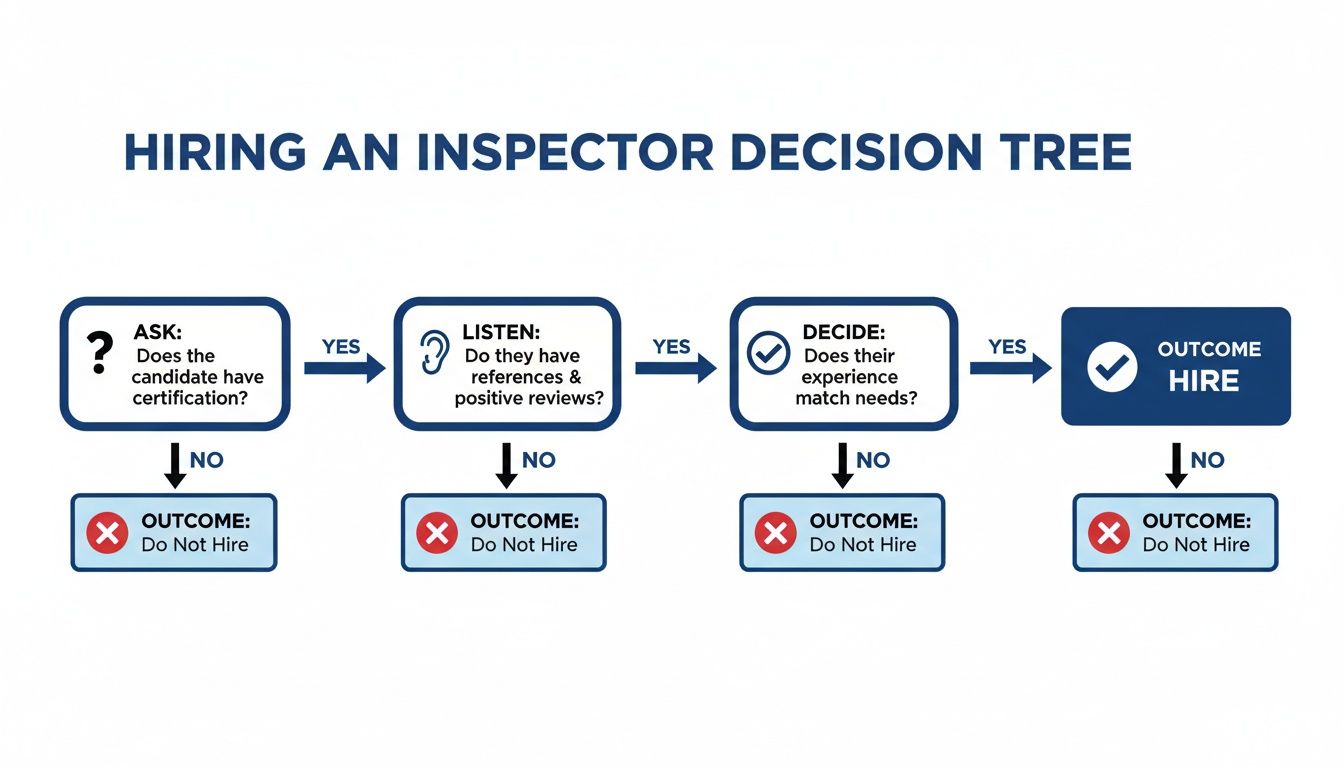
Ultimately, this flow shows that a methodical approach—asking, listening, and then deciding—is what leads to a confident and informed choice.
What Defines a High-Quality Report
Before you hire anyone, you must ask to see a sample report. Any inspector worth their salt will have one ready to go. This is your chance to see the kind of work they produce firsthand. For a great example of what to look for, check out this detailed sample home inspection report to get a feel for the level of detail and clarity you should expect.
A quality report really boils down to a few key things:
- A Clear Summary: The big-ticket items—the potential deal-breakers—should be summarized right at the beginning. This lets you and your agent quickly see what matters without having to dig through 50 pages of text.
- Actionable Recommendations: The report shouldn't just identify defects; it needs to provide clear next steps. Whether it's "monitor this area" or "immediate evaluation by a licensed electrician is recommended," you should never be left wondering what to do next.
- High-Resolution, Annotated Photos: Clear images are non-negotiable. The best reports use arrows, circles, or other callouts to show you exactly where the problem is, removing any doubt or ambiguity.
This level of detail is what transforms a report from a simple list of flaws into a powerful negotiation tool and, down the road, a practical maintenance manual for your new home.
Going Beyond the Standard Inspection with Add-On Services
A standard home inspection is comprehensive, but it doesn't cover absolutely everything. That's where specialized add-on services come in, offering a deeper dive into specific systems and potential environmental hazards. Knowing when to opt for these extras is a huge part of tailoring the inspection to the specific property you're looking at.
Not every home needs every test, but in certain situations, these add-ons are an incredibly wise investment.
Opting for specialized add-on services isn't an upsell; it's a strategic decision to gain a complete understanding of a property's health, especially when specific risk factors are present.
Deciding Which Ancillary Services You Need
Your decision should be based on the home's age, location, and unique characteristics. An experienced local inspector can offer priceless guidance on which services are most relevant for your area.
Here’s a breakdown of common add-ons and when you should seriously consider them:
- Sewer Scope: This is where a camera is sent down the main sewer line to check for cracks, blockages, or tree root intrusion. It's an absolute must-have for homes built before 1980, as older pipes are prone to collapse or damage. A surprise $10,000 sewer line replacement after closing is a financial nightmare you want to avoid.
- Radon Testing: Radon is a colorless, odorless radioactive gas that can seep into homes from the ground. Since it's the second leading cause of lung cancer in the U.S., testing is recommended for all homes, particularly those with basements or in known high-radon areas.
- Mold Screening: If you notice a musty smell, see visible water damage, or know the property has a history of leaks, a mold screening is essential. This usually involves taking air samples and surface swabs to identify the presence and type of mold.
- Thermal Imaging: Using an infrared camera, inspectors can literally "see" temperature differences in walls, ceilings, and floors. This tech is incredibly effective at spotting hidden moisture intrusion, missing insulation, and even electrical hot spots that are totally invisible to the naked eye.
Talking through these options with your inspector beforehand allows you to create a customized inspection plan. This ensures you get the full picture of the property's condition, leaving no stone unturned and empowering you to move forward with complete confidence.
Spotting Red Flags and Common Mistakes to Avoid
Hiring the wrong inspector can be just as damaging as skipping the inspection altogether. A huge part of learning how to choose a home inspector is knowing what not to look for. Spotting the warning signs early on can save you from a massive, costly headache down the road.
The biggest, brightest red flag you can encounter is a conflict of interest. If an inspector finds a problem and immediately offers to fix it for you, run—don't walk—away. Their only job is to provide an unbiased, objective evaluation of the property. The moment they have a financial stake in the repairs, that objectivity is gone.
The Problem with Conflicts of Interest
Think about it: your inspector finds "major issues" with the roof and then slides you a business card for their roofing company. How can you trust their assessment? You're left wondering if the problems are really that severe or if they're being hyped up to land a profitable side gig. This is a serious ethical breach.
A professional home inspector's role is to inspect and report. Period. They should never offer to bid on or perform repairs for issues they discover. This is a non-negotiable ethical line and a core principle for respected associations like ASHI and InterNACHI.
This clear separation of duties ensures the advice you get is purely for your benefit. Their findings should empower you to find your own qualified, independent contractors for estimates, not funnel business into their own pockets.
Common Traps Buyers Fall Into
Beyond the obvious conflicts of interest, there are a few common traps that buyers fall into when hiring an inspector. It’s crucial to stay objective and remember that this decision is about protecting your investment.
Defaulting to the Cheapest Option: I get it, buying a home is expensive. But the inspection is not the place to pinch pennies. A fee that's way below the local average is often a sign of inexperience, a lack of proper insurance, or an inspector who rushes through jobs. The few hundred dollars you "save" now could cost you thousands later.
Blindly Trusting a Referral: Referrals are a great starting point, but they should never be the only reason you hire someone. This is especially true if the referral comes from the seller's agent, who has a vested interest in the deal closing smoothly and quickly. Always, always do your own homework.
Ignoring Online Reviews and Sample Reports: Skipping due diligence is a recipe for disaster. Not checking Google reviews or reading a sample report means you’re hiring blind. These are your best tools for seeing their professionalism, communication style, and the actual quality of their work before you commit.
Real-World Scenarios and Their Consequences
Let me paint a picture for you. A buyer is eager to close and just goes with their agent's first recommendation without a second thought. The inspector breezes through the house in 90 minutes, hands over a vague checklist report, and completely misses the subtle signs of a slow leak behind a bathroom wall.
Six months after closing, the new homeowners discover a massive mold problem that ends up costing $15,000 in remediation and repairs. This isn't just a scary story; situations like this happen all the time when buyers value speed over thoroughness. A diligent inspector would have pulled out a moisture meter and thermal camera, spotted the water intrusion, and saved that client from a financial nightmare.
The bottom line is simple: the person you hire to inspect your potential home must be independent, thorough, and working only for you. Taking the time to properly vet them isn't just another task—it's one of the most important steps in your entire home-buying journey. It's your best defense against unwelcome surprises.
What to Do After You Get the Inspection Report
The moment that inspection report lands in your inbox, it can feel like the final exam of your home-buying marathon. These reports are often long, technical, and packed with photos of things you never knew existed in a house. Don't let it overwhelm you. This document isn't a list of failures; it's your strategic roadmap for what comes next.
Your first move is to read through the entire report once, just to get a feel for it. Then, go back and start sorting every single item the inspector noted into one of three simple categories. This simple trick will bring immediate clarity to the chaos.
Sort and Prioritize the Findings
Think of it like a triage system for the property. Categorizing the findings helps you cut through the noise and focus on what truly matters, separating the genuine deal-breakers from the minor weekend projects.
Deal-Breakers and Major Concerns: These are the big-ticket, show-stopping issues. We’re talking about serious structural foundation problems, a roof that's on its last legs, active leaks causing widespread damage, or dangerous electrical hazards. These are the problems that carry a hefty price tag and can seriously impact the safety and integrity of the home.
Important but Manageable Repairs: This bucket holds the items that definitely need attention but aren't immediate emergencies. Things like a water heater nearing the end of its life, a few leaky faucets, or a deck that needs to be resealed all fall in here. These are your prime negotiation points.
Minor Fixes and Future Maintenance: Here’s where you’ll toss all the cosmetic stuff. Cracked tiles, loose cabinet hardware, or scuffed walls that need a fresh coat of paint. These are typically the "honey-do" list items you'll likely handle yourself after you've moved in.
Your inspection report isn’t just a list of problems; it’s one of the most powerful negotiation tools you have. How you use it can directly impact your final purchase price and the money you spend on repairs right after closing.
Formulate Your Negotiation Strategy
With your categorized list in hand, it's time to sit down with your real estate agent and build a game plan. The goal isn't to get the seller to fix every single scuff and squeak. Instead, you'll want to focus on the significant issues from your first two categories.
You really have two main ways to go about this. You can ask the seller to hire contractors and perform specific repairs before closing, or you can request a repair credit (or a reduction in the sale price) to handle them yourself.
Honestly, most experienced agents and buyers prefer asking for credits. Why? Because it puts you in the driver's seat. You get to oversee the repairs, hire contractors you've vetted and trust, and ensure the job is done right—not just done cheaply by the seller who is on their way out.
For instance, if the inspector notes the HVAC system is old and struggling, asking for a $5,000 credit towards a new unit gives you total control over the brand and quality of the replacement. This kind of strategic approach, all guided by that clear, detailed report, is what lets you move forward with confidence, knowing you're making a sound investment.
Your Top Questions Answered
Even when you've done your homework, picking the right home inspector can feel like a make-or-break moment in the buying process. Let's tackle some of the questions that come up time and time again.
Should I Use the Inspector My Realtor Recommends?
Getting a referral from your agent is an excellent place to start—they've worked with dozens of inspectors and usually know who is professional and doesn't miss a thing.
But it shouldn't be your only step. You still need to do your own homework. Look up their reviews, check their state license and certifications, and always ask to see a sample report. The final call is yours, so make sure you’re 100% confident in who you hire.
What’s the Average Cost of a Home Inspection?
The price tag can swing quite a bit depending on where you are, how big and old the house is, and what extra services you might need, like radon or mold testing.
Generally, you can budget for $300 to $600 for a standard inspection. It can be tempting to go with the cheapest option you find, but be careful. A bargain-basement price can sometimes mean you're getting someone with less experience who might not be as thorough.
Don't think of it as a cost—it's an investment. Paying a bit more for a seasoned inspector can literally save you thousands by catching a major issue that a less diligent one might overlook.
Does the Seller Get a Copy of the Report?
Absolutely not. The inspection report is produced for you, the client who paid for the service. It’s your property.
You and your real estate agent have complete control over who sees that report. You'll work together to decide what information, if any, you want to share with the seller when it comes time to negotiate repairs or credits.
Do I Need to Be Present for the Inspection?
While you don't have to be there for the entire inspection, it is highly recommended that you show up, at least for the final summary at the end.
Being there is a golden opportunity to see potential issues with your own eyes and ask your inspector questions on the spot. It brings the report to life, transforming it from just a PDF into a real-world walkthrough of your potential new home.
When it comes to protecting your investment in the Memphis area, a thorough, professional inspection is non-negotiable. Upchurch Inspection provides the detailed reports and expert insights you need to make a confident decision. Schedule your inspection today.