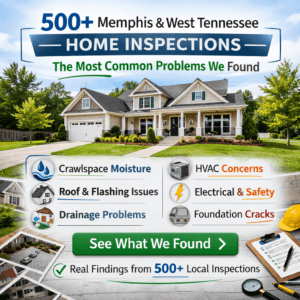

Homes across the Mid-South share more in common than many buyers realize. While architecture and neighborhoods vary, properties in Tennessee, Arkansas, Missouri, Kentucky, and Mississippi are all influenced by similar soil behavior, humidity levels, and weather patterns. These environmental factors shape how homes age, how problems develop, and what inspectors pay close attention to during an inspection.
Understanding this regional context helps explain why certain issues appear repeatedly in inspection reports across the Mid-South.
Expansive and Moisture-Sensitive Soils
Much of the Mid-South is built on clay-rich soils that expand when wet and contract when dry. This constant cycle places stress on foundations over time. Rather than causing sudden failure, this movement typically shows up gradually as minor settlement, floor unevenness, or cracking in interior finishes.
Inspectors look for patterns that suggest how a home has responded to these conditions over many years. A house that shows consistent, stable movement often tells a very different story than one showing signs of recent or uneven change.
Humidity Plays a Bigger Role Than Temperature
Humidity is one of the most influential factors affecting homes in this region. Long cooling seasons, frequent rainfall, and high outdoor moisture levels create conditions where moisture management becomes critical.
This is why inspections across the Mid-South tend to focus heavily on crawlspaces, basements, attics, and ventilation. Elevated humidity can affect framing, insulation, HVAC performance, and indoor air quality even when no obvious water intrusion is present.
Crawlspaces Reflect Regional Conditions
Crawlspace construction is common throughout the Mid-South, and these areas often provide the clearest picture of how soil and climate are interacting with a home. Moisture beneath the house, vapor barrier condition, and airflow patterns all reflect exterior conditions more directly than living spaces do.
Inspectors use crawlspaces to assess drainage effectiveness, long-term moisture exposure, and how well the home is managing the environment it sits in.
Rainfall Patterns Reveal Drainage Weaknesses
Homes in the Mid-South are regularly tested by heavy or prolonged rain events. Drainage systems that perform adequately most of the year may struggle during these periods, revealing grading issues, runoff concentration, or weak points in water management.
Inspection findings related to moisture often trace back to how water moves across the property during storms rather than isolated interior defects.
Seasonal Movement Is Often Normal
One of the most important concepts inspectors communicate to buyers is that some degree of seasonal movement is normal in this region. Doors that behave differently at different times of year, hairline cracks that appear and disappear, and minor floor changes are often tied to moisture cycles rather than structural failure.
The key is understanding whether a home has adapted to these conditions over time or whether movement appears progressive or uneven.
Construction Practices Adapted to the Region
Homes across the Mid-South were often built with regional conditions in mind, even if those methods look different from modern practices elsewhere. Larger framing lumber, crawlspace foundations, and certain ventilation approaches reflect local building traditions shaped by climate.
Inspectors evaluate these systems based on performance and condition rather than comparing them directly to homes built in different regions.
Why Regional Experience Matters
Inspecting homes in the Mid-South requires more than a checklist. It requires understanding how soil, moisture, and climate interact with construction over decades. Inspectors who work regularly across this region recognize recurring patterns and know when a condition is typical versus when it suggests elevated risk.
That regional perspective helps buyers interpret inspection findings accurately and make decisions based on long-term performance rather than unfamiliarity with local conditions.