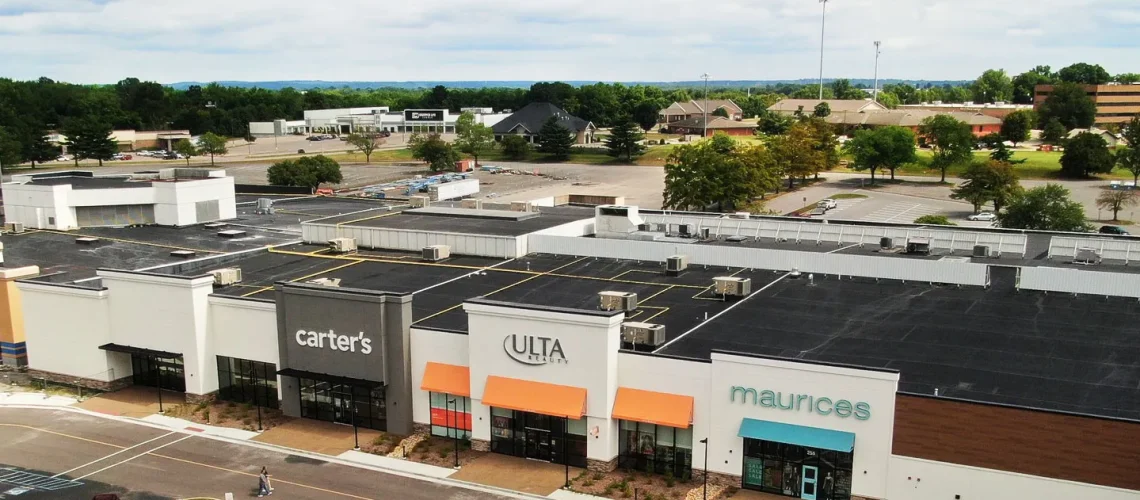
Fast growth leaves fingerprints, and nowhere is that more obvious than in Cape Girardeau’s expanding commercial corridors. Along Cape West Parkway and Siesta Drive, large retail and mixed-use buildings went up quickly to meet demand. Speed keeps projects on schedule, but it also creates predictable inspection problems once the doors open and systems are under load.
Big-box buildings don’t usually fail dramatically. They fail quietly, through shortcuts that only show up when you know where to look.
Flat Roofs and the Drainage Shortcut
Most of these properties rely on low-slope membrane roofing systems. On paper, they’re simple. In practice, drainage design is where corners get cut. I routinely see:
- Inadequate slope toward primary drains
- Poorly installed scuppers
- Secondary (overflow) drains that are undersized or blocked
When water doesn’t evacuate fast enough, it ponds. Ponding adds load, accelerates membrane deterioration, and increases the likelihood of interior leaks that don’t show up until tenant build-outs are complete.
Thermal Bridging in Fast-Built Shells
Commercial shells in this corridor are often constructed with steel framing and large open spans. Without careful detailing, those steel members become highways for heat transfer. This is classic thermal bridging.
Thermal bridging leads to:
- Condensation on interior wall and ceiling surfaces
- Mold growth behind finished tenant walls
- Inefficient HVAC performance and uneven comfort zones
These issues don’t show up on a casual walkthrough. They show up when the building is operating — and by then, tenants are already complaining.
HVAC Balancing Gets Overlooked
Big-box HVAC systems are frequently installed to meet square-footage requirements, not actual airflow performance. I see improperly balanced systems where one side of the building is over-conditioned while another struggles to maintain temperature.
That imbalance stresses compressors, increases energy costs, and shortens equipment life. It’s especially common in buildings that were designed as speculative shells and later divided for multiple tenants.
Expansion Joints and Structural Movement
Large retail footprints depend on properly designed and maintained expansion joints. When these joints are missing, improperly sealed, or bridged over during interior finish work, the building loses its ability to move as designed.
That’s when cracks appear in drywall, ceiling grids separate, and doors start binding — all signs of structural movement that owners often mistake for “normal settling.”
Why Commercial Inspections Here Demand Experience
Inspecting commercial properties in Cape’s westward expansion isn’t about checking boxes. It’s about understanding how speed, scale, and design shortcuts interact once the building is occupied and operating.
For investors and owners evaluating commercial properties across Southeast Missouri, thorough due diligence is critical before acquisition.
Learn more about how we approach commercial inspections in the region here:
https://upchurchinspection.com/our-service-areas/home-inspections-in-southeast-missouri/
In fast-growing corridors like Cape West Parkway, the problems aren’t hidden — they’re just built in early.