
This is one of those HVAC issues where a lot of people — including some technicians — guess instead of verify.
Warm air coming out of the vents? First reaction is usually, “Must be low on refrigerant.”
Sometimes that’s true. A lot of times, it isn’t.
This is where thermal imaging earns its keep.
Why These Two Problems Get Confused
Dirty evaporator coils and low refrigerant charge can produce very similar symptoms:
- Weak cooling
- Uneven temperatures between rooms
- Long run times
- Ice forming on the coil or suction line
But the fix is completely different — and guessing wrong can cost a buyer real money.
A Real Inspection Where the Camera Changed the Call
I inspected a home in Cordova where the AC wasn’t keeping up. Seller said it “just needed a little Freon.”
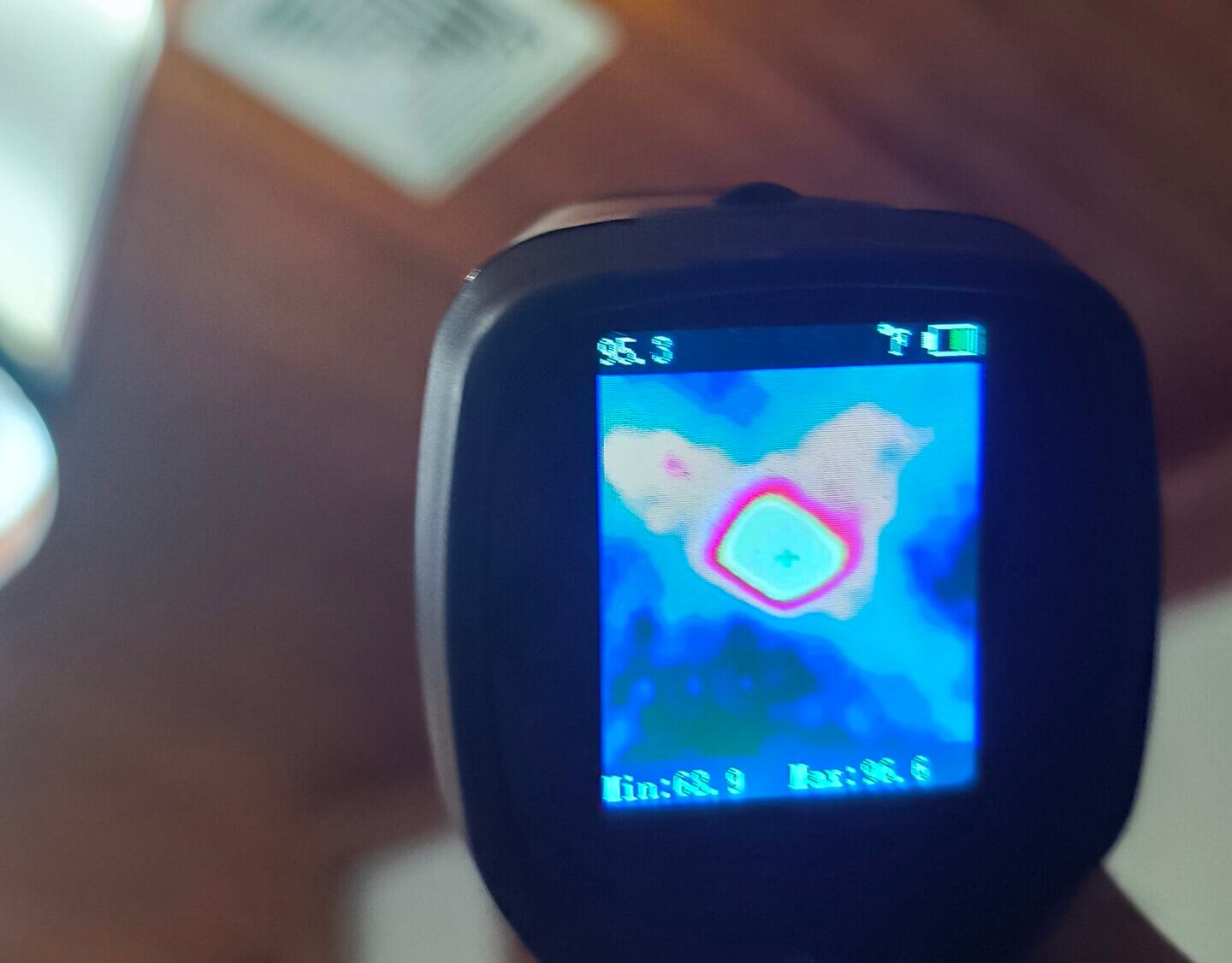
Thermal camera told a different story.
The evaporator coil showed patchy temperature patterns instead of a smooth, even cooling profile. Some sections were ice-cold, others barely doing anything.
Pulled the access panel and found the coil packed with dust and construction debris from a remodel that happened years earlier. The system wasn’t low on refrigerant — it was choking on dirt.
Had that buyer called for a refrigerant recharge first, they would’ve paid for the wrong repair and still had a problem.
What Dirty Coils Look Like on Thermal Imaging
When coils are dirty, I usually see:
- Uneven cooling across the coil face
- Hot and cold spots side by side
- Reduced airflow temperature drop
- Signs of ice forming in isolated areas
Air can’t move evenly across a clogged coil. Thermal imaging makes that obvious immediately.
What Low Refrigerant Looks Like Instead
Low refrigerant tells a different story:
- Gradual temperature change along the coil
- Abnormally cold sections near the metering device
- Consistently weak Delta-T
- Frost patterns that follow the refrigerant path
I inspected a home in Bartlett where the thermal camera showed a cold streak starting at the expansion valve and fading fast. That’s a classic low-charge signature.
Turned out a line-set fitting had been leaking slowly for years.
Why Guessing Gets Expensive
Here’s what I see happen all the time:
- Homeowner tops off refrigerant
- Coil stays dirty
- System efficiency doesn’t improve
- Compressor runs hotter
- Failure comes sooner
I’ve also seen the opposite — coils get cleaned, but a refrigerant leak goes unaddressed and the system fails anyway.
You have to know which problem you’re dealing with.
Why I Don’t Rely on “Feel”
Standing under a vent and saying “it feels cool” tells me nothing.
Thermal imaging lets me:
- See airflow distribution
- Compare temperature patterns
- Spot restrictions instantly
- Back up my findings visually
It’s especially useful in homes where access to the full coil is limited or sealed.
What Buyers Should Take Away
If an HVAC system isn’t performing:
- Don’t assume it’s refrigerant
- Don’t assume it’s dirty coils
- Don’t accept vague explanations
Those two issues look similar on the surface but leave very different fingerprints when you know where to look.
The Inspector’s Bottom Line
Thermal imaging doesn’t guess — it shows.
Dirty coils and low refrigerant both hurt performance, but fixing the wrong one wastes money and time. I use the camera because HVAC problems rarely announce themselves clearly.
The system always tells the truth — if you know how to read it.