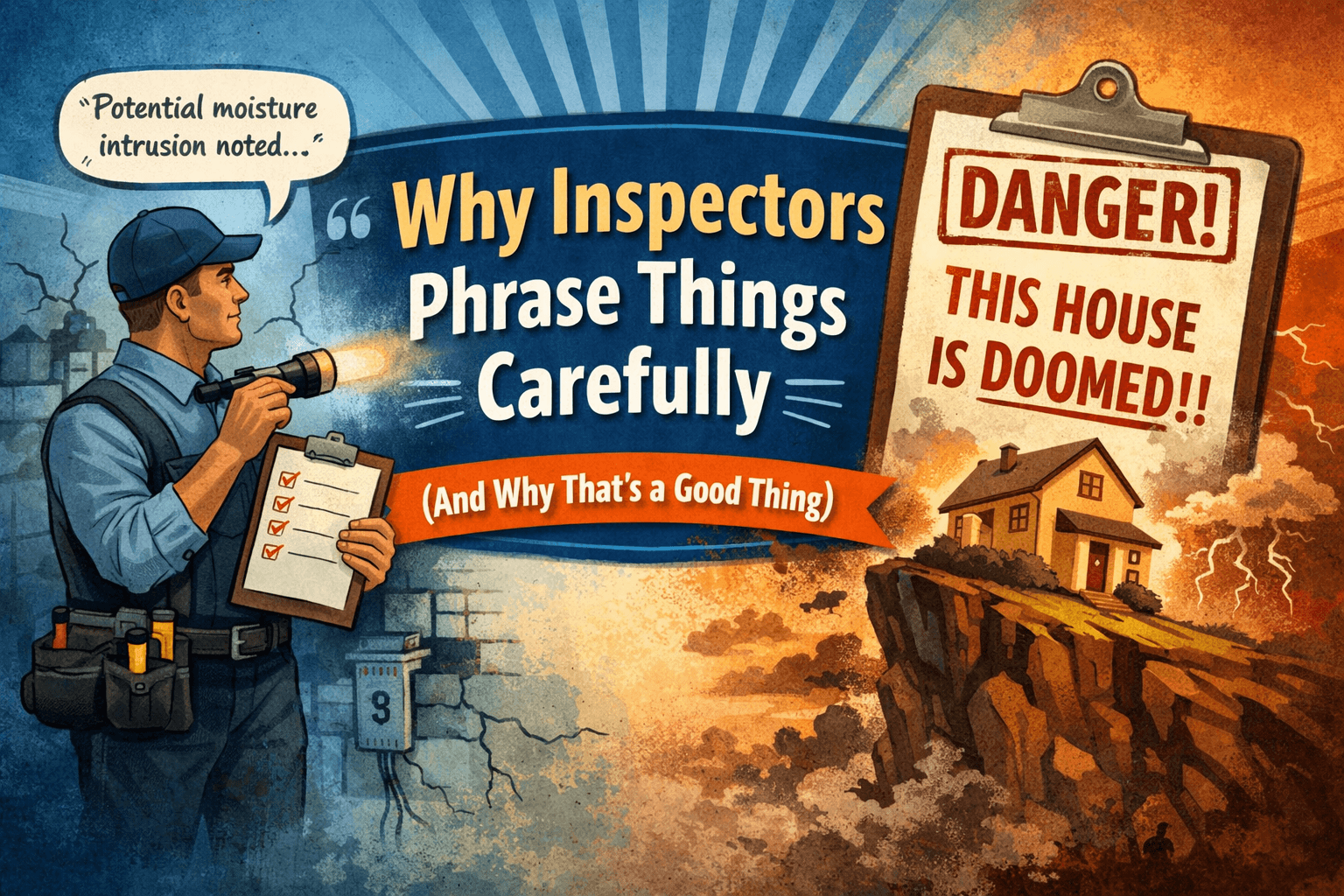
One of the first things buyers notice when reading an inspection report is the language. It can feel cautious. Sometimes repetitive. Occasionally frustratingly noncommittal.
“This may indicate…”
“This could lead to…”
“Recommend further evaluation…”
To someone who isn’t used to inspection reports, that wording can sound evasive. Like the inspector is hedging or refusing to give a straight answer.
In reality, that careful phrasing is one of the most important parts of a responsible inspection, and it’s something we’re very intentional about at Upchurch Inspection.
Homes Rarely Offer Certainty — Language Has to Reflect That
A home inspection is a snapshot in time. We’re evaluating systems under limited conditions, without disassembly, and without seeing how the house behaves over weeks, months, or seasons.
Because of that, absolute statements are rarely honest.
If we say something will fail, and it doesn’t, we’ve misrepresented reality. If we say something won’t be a problem, and it is, we’ve done the same.
Careful language isn’t about protecting ourselves—it’s about accurately reflecting uncertainty where uncertainty exists.
A Real Example: Moisture Without Active Leaks
We often see signs of past or intermittent moisture: staining, material deterioration, elevated humidity, or repairs that suggest something happened before.
At the time of inspection, there may be no active leak. Everything is dry.
Saying “there is a leak” would be inaccurate. Saying “there is no issue” would be irresponsible.
So we say what’s true: the condition suggests moisture has occurred and could occur again under the right conditions.
That language doesn’t dodge the issue. It defines it honestly.
Why Inspectors Avoid Declaring Root Causes Without Evidence
Buyers often want to know why something happened.
Sometimes we can tell. Sometimes we can’t—at least not without invasive testing or extended observation.
For example, cracking in a wall might be related to settlement, seasonal movement, past moisture, or previous repairs. Declaring a single cause without sufficient evidence would be speculation.
Instead, inspectors explain plausible explanations and focus on what matters most: whether the condition is stable, active, or worth monitoring.
That distinction is far more useful than a confident guess.
Careful Language Prevents False Confidence
One of the biggest risks in real estate isn’t fear—it’s misplaced confidence.
When reports are written in absolute terms, buyers may assume risks are resolved or nonexistent. That’s how small issues get ignored until they become expensive ones.
Language that acknowledges uncertainty encourages buyers to:
- Pay attention
- Monitor conditions
- Budget realistically
- Ask follow-up questions
That mindset leads to better ownership experiences.
Why “Recommend Further Evaluation” Exists
This phrase frustrates buyers more than almost any other.
It’s often interpreted as a cop-out. In reality, it’s an acknowledgment of scope.
Inspectors are generalists. When we see conditions that fall outside the limits of a general inspection—or when the cause and severity can’t be determined visually—we recommend evaluation by someone with the tools, access, or licensing to go deeper.
That’s not passing the buck. It’s staying in our lane.
How Overconfidence Hurts Buyers
We’ve seen the consequences of overconfident reports written elsewhere.
Issues dismissed too casually. Risks minimized. Language that sounded reassuring but wasn’t grounded in evidence.
Those reports feel good at closing—and create frustration later.
Careful language may feel unsatisfying in the moment, but it holds up over time. It aligns expectations with reality instead of masking it.
How We Use Language at Upchurch Inspection
We choose words deliberately.
Not to sound technical. Not to cover ourselves. But to match the level of certainty the evidence actually supports.
When we know something, we say it clearly.
When something is likely, we explain why.
When uncertainty exists, we acknowledge it openly.
That honesty builds trust—not just at closing, but months or years later when buyers look back and realize the report prepared them for what came next.
What Buyers Should Listen For Instead of Absolutes
Rather than focusing on whether an inspector sounds certain, buyers should listen for:
- Patterns
- Context
- Explanations tied to observable conditions
- Clear reasoning
Those elements matter far more than definitive-sounding statements ever could.
Inspection language isn’t designed to be comforting. It’s designed to be accurate.
When buyers understand that, careful phrasing stops feeling like hesitation and starts feeling like professionalism—because it is.