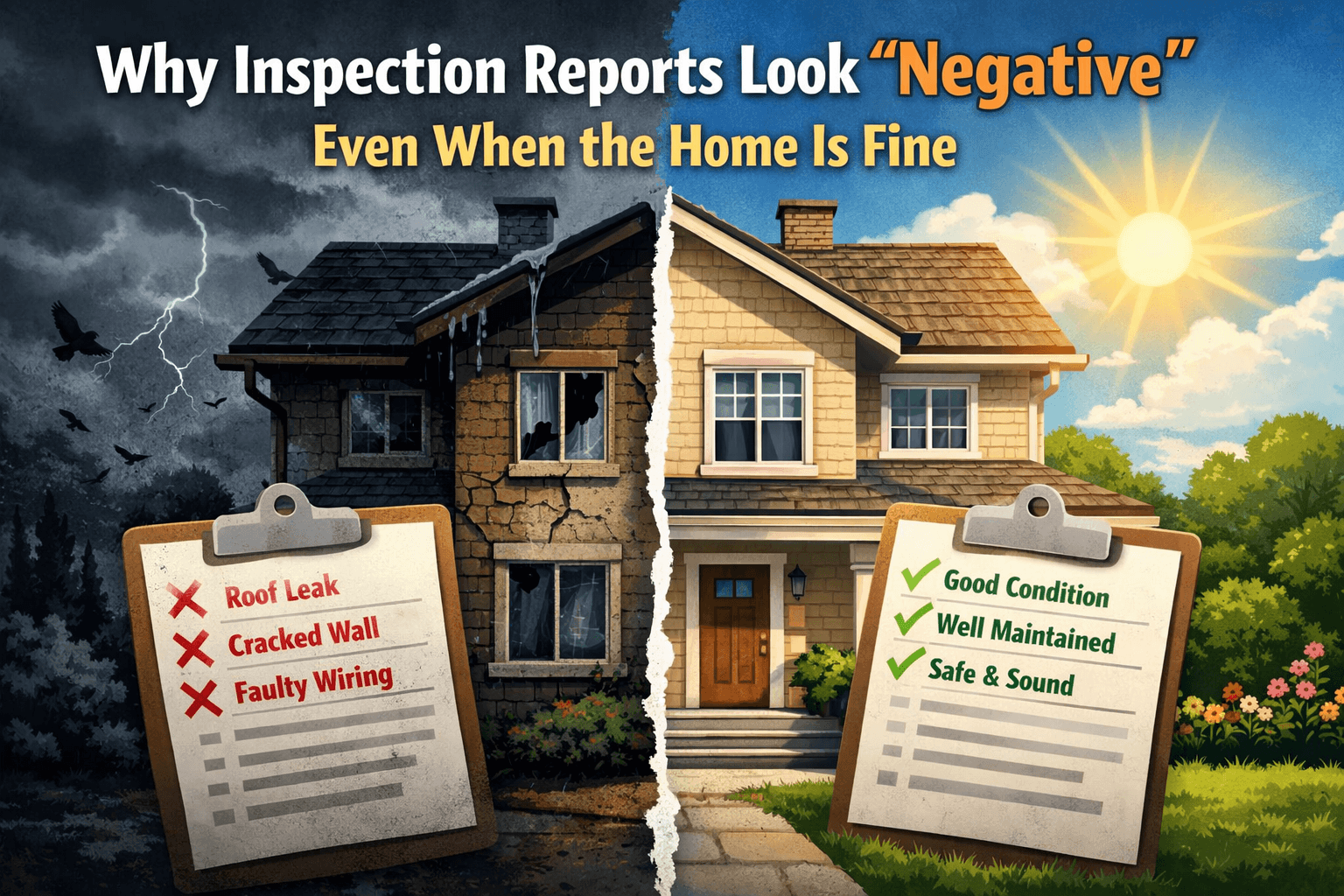
It’s common for buyers to open an inspection report and feel a moment of panic. Page after page of issues. Photos with arrows. Language that feels serious. Even when the house felt solid during the walkthrough, the report can read like a catalog of problems.
We hear it all the time:
“Is this house worse than we thought?”
“Is this a bad inspection?”
Usually, the answer is no. What’s happening is a disconnect between how inspection reports are structured and how people naturally interpret information.
Inspection Reports Are Designed to Document Risk, Not Reassurance
Inspection reports aren’t summaries of what’s good about a home. They’re records of conditions that matter.
If a system is working normally and shows no visible defects, there’s often very little to say about it. When something shows wear, risk, or limitation, it gets documented—sometimes in detail.
That imbalance makes reports feel negative by default. Silence means acceptable. Commentary means attention required.
A home with a long report isn’t automatically a bad home. It’s often just a well-documented one.
The Inspector’s Job Is to Assume Nothing
During an inspection, we don’t assume intent, quality, or future performance. We document what we see.
That means calling out:
- Minor defects
- Early signs of wear
- Conditions that may never become problems
- Issues that only matter under certain circumstances
From a homeowner’s perspective, some of these feel nitpicky. From an inspection standpoint, leaving them undocumented would be a mistake.
The goal is not to alarm—it’s to avoid omission.
A Real Example: The “Perfect” Roof That Still Gets Noted
We’ve inspected roofs that had no leaks, no visible damage, and no immediate concerns. Yet the report still mentions age, typical service life, or areas to monitor.
That doesn’t mean the roof is failing. It means the roof exists in time.
Inspection language often reads cautious because it has to be defensible. We don’t get to say, “This will probably be fine.” We say what we know, what we see, and what that typically leads to.
Why Neutral Language Still Feels Critical
Inspection reports are written to be clear and factual, not encouraging.
Phrases like “recommend further evaluation” or “monitor for changes” aren’t warnings of imminent failure. They’re acknowledgments of uncertainty.
To buyers unfamiliar with inspection language, uncertainty feels negative. In reality, it’s honesty.
A report that pretends certainty exists where it doesn’t would be far more misleading.
Photos Change How People Read Reports
Photos make reports feel heavier.
Seeing arrows, circles, and close-ups naturally triggers concern, even when the issue is minor. A small crack looks dramatic when it fills a screen. A slightly corroded fitting looks worse when zoomed in.
Photos aren’t there to exaggerate. They’re there to document conditions clearly so everyone is looking at the same thing.
The emotional weight comes from visual focus, not severity.
Why Inspectors Don’t Rank Homes as “Good” or “Bad”
Buyers often want a summary judgment. Is this a good house or a bad one?
Inspection reports don’t answer that because it’s not an inspection question. It’s a decision question.
A home with several documented issues may still be a great purchase at the right price. A home with fewer issues may still be a poor fit depending on the buyer’s plans and tolerance.
Reports give information. Buyers make choices.
How We Explain This at Upchurch Inspection
We spend a lot of time helping clients read reports correctly.
We explain:
- Which issues affect safety
- Which issues affect budgeting
- Which issues are typical for the home’s age
- Which issues simply deserve monitoring
Once buyers understand that framework, reports stop feeling like indictments and start feeling like tools.
The Mistake Buyers Make After Reading the Report
The most common mistake is treating all comments as equal.
A loose handrail, an aging HVAC system, and a cosmetic crack do not carry the same weight—but they may all appear similar on paper.
This is why conversations matter. Reports capture information. Interpretation gives it meaning.
Why a “Short” Report Isn’t Always Better
Some buyers feel relieved by short reports and alarmed by long ones.
In practice, shorter reports often reflect:
- Newer homes
- Less visible wear
- Or less detailed documentation
None of those guarantee fewer future problems.
A thorough report doesn’t mean the inspector found more wrong. It means the inspector took the time to explain what was found.
Inspection reports are not verdicts. They’re records.
When buyers understand that the report is documenting risk—not condemning the house—the tone changes. The same information that once felt overwhelming becomes grounding, because it replaces assumption with clarity.
That clarity is exactly what inspections are meant to provide.