One of the questions we hear most often during inspections sounds simple on the surface:
“How long do you think this will last?”
Buyers ask it about roofs, HVAC systems, water heaters, and almost everything in between. It’s a fair question. People want timelines. They want to plan. They want certainty.
What they don’t always realize is that estimating remaining useful life isn’t about predicting failure dates. It’s about interpreting patterns, conditions, and context—without pretending to know the future.
At Upchurch Inspection, we’re careful with this conversation, because guessing creates false confidence, and false confidence is far more damaging than uncertainty.
Why “How Long Will It Last?” Is the Wrong Starting Point
No component in a home comes with a countdown clock.
Two identical systems installed on the same day can age very differently depending on:
- Usage patterns
- Maintenance history
- Installation quality
- Environmental exposure
We’ve seen HVAC systems fail in half their expected lifespan and others run well past it. The difference wasn’t luck. It was context.
That’s why inspectors don’t say, “This will last five more years.” What we do instead is explain where the system sits in its lifecycle and how much margin it has left.
Age Is a Reference Point, Not a Verdict
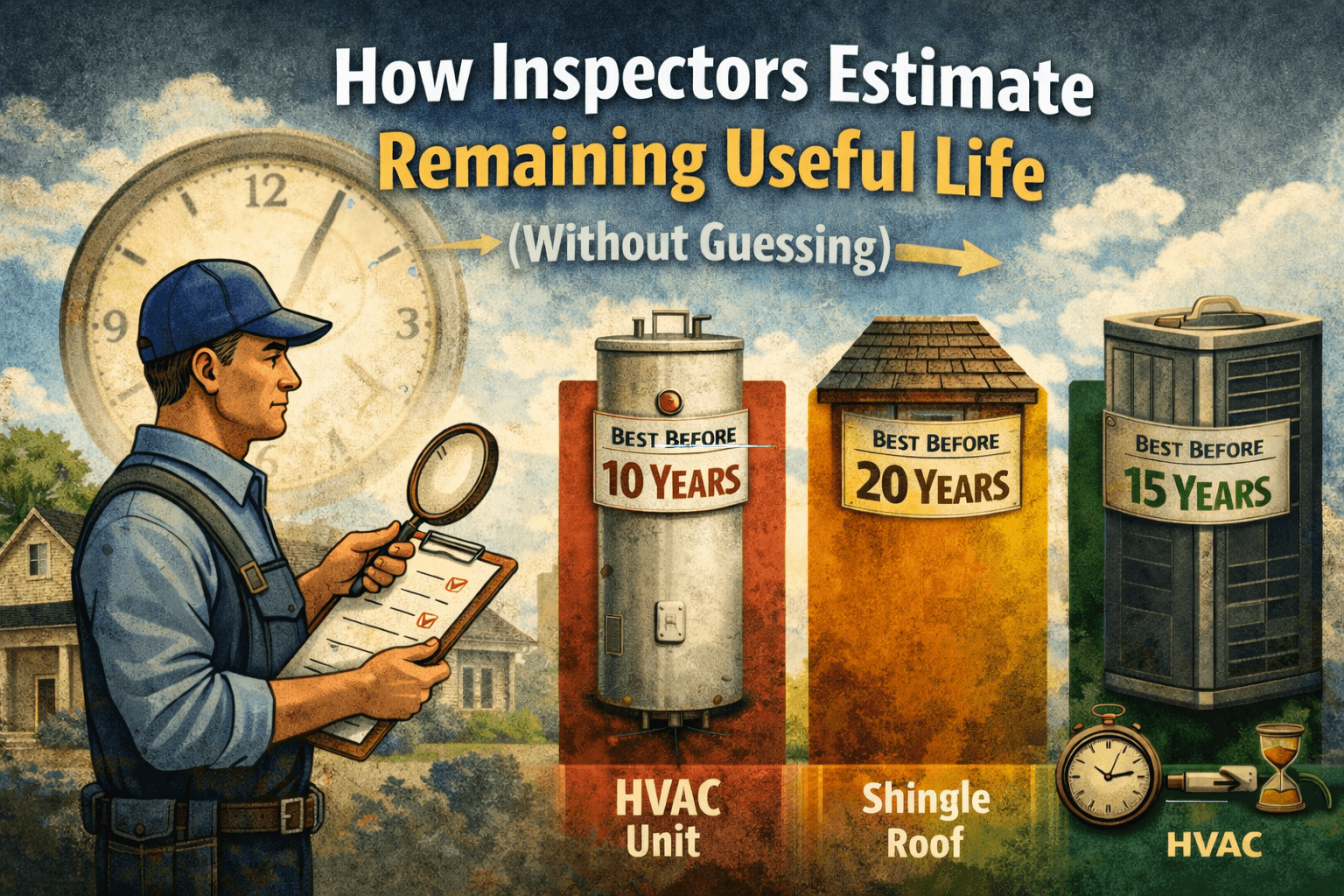
Manufacturers publish typical service life ranges for systems and materials. Those ranges give us a baseline.
When we say a system is “near the end of its expected lifespan,” we’re not predicting immediate failure. We’re saying the system has entered a phase where:
- Failure becomes more likely
- Repairs become more frequent
- Replacement planning makes sense
A roof that’s 18 years into a 20-year shingle rating isn’t broken just because of its age. But it also doesn’t have much room left for surprises.
Condition Tells Us More Than Age Alone
This is where inspection experience matters.
We look at how a system has aged, not just how long it’s been there.
For example:
- An older HVAC system that’s clean, evenly worn, and properly installed often has more usable life than a newer system that’s poorly installed or overworked.
- A roof with uniform wear and good drainage history is very different from a roof of the same age showing patchwork repairs and moisture intrusion.
Condition helps us assess whether aging has been normal or accelerated.
Maintenance History Leaves Clues
Even when records aren’t available, maintenance leaves evidence.
Clean components, intact seals, consistent materials, and proper clearances usually indicate routine care. Corrosion, improvised repairs, mismatched parts, or bypassed safety features suggest neglect or reactive maintenance.
We’re not just evaluating what’s there—we’re evaluating how it got that way.
That story matters when estimating how much useful life remains.
Environment Speeds Things Up or Slows Them Down
Where a home is located affects how quickly systems age.
In our region, humidity, soil conditions, and seasonal swings take a toll. Systems that might last longer in dry or mild climates often age faster here.
A water heater in a damp crawl space ages differently than one in a conditioned utility room. A roof shaded by trees ages differently than one in full sun.
Remaining useful life isn’t universal. It’s local.
Why Inspectors Avoid Specific Timelines
Buyers sometimes get frustrated when inspectors won’t give exact numbers.
That hesitation isn’t evasiveness—it’s honesty.
Giving a specific timeline implies certainty that doesn’t exist. When a system fails earlier than predicted, buyers feel misled. When it lasts longer, they may defer planning and get caught off guard later.
By framing remaining life in ranges and risk levels, inspectors give buyers something more useful than a date: a planning window.
What Buyers Should Take Away Instead
Instead of focusing on “how long,” buyers are better served by asking:
- Is this system early, middle, or late in its lifecycle?
- Does its condition suggest normal aging or accelerated wear?
- What happens when it fails—minor inconvenience or major disruption?
- Am I prepared for replacement if it happens sooner than expected?
Those answers support better decisions than any guess ever could.
How We Handle This Conversation at Upchurch Inspection
When clients ask about remaining useful life, we slow the conversation down.
We explain:
- What’s typical for the system
- What we’re seeing in this specific home
- How environment and usage factor in
- What planning looks like from a homeowner’s perspective
We don’t try to predict failure. We try to remove surprises.
That approach gives buyers something far more valuable than a guess—it gives them context they can actually use.
Homes don’t fail on schedules. They fail when time, use, and conditions intersect.
A good inspection doesn’t pretend otherwise. It helps buyers understand where those intersections are most likely to happen, so they can move forward with realistic expectations instead of artificial certainty.