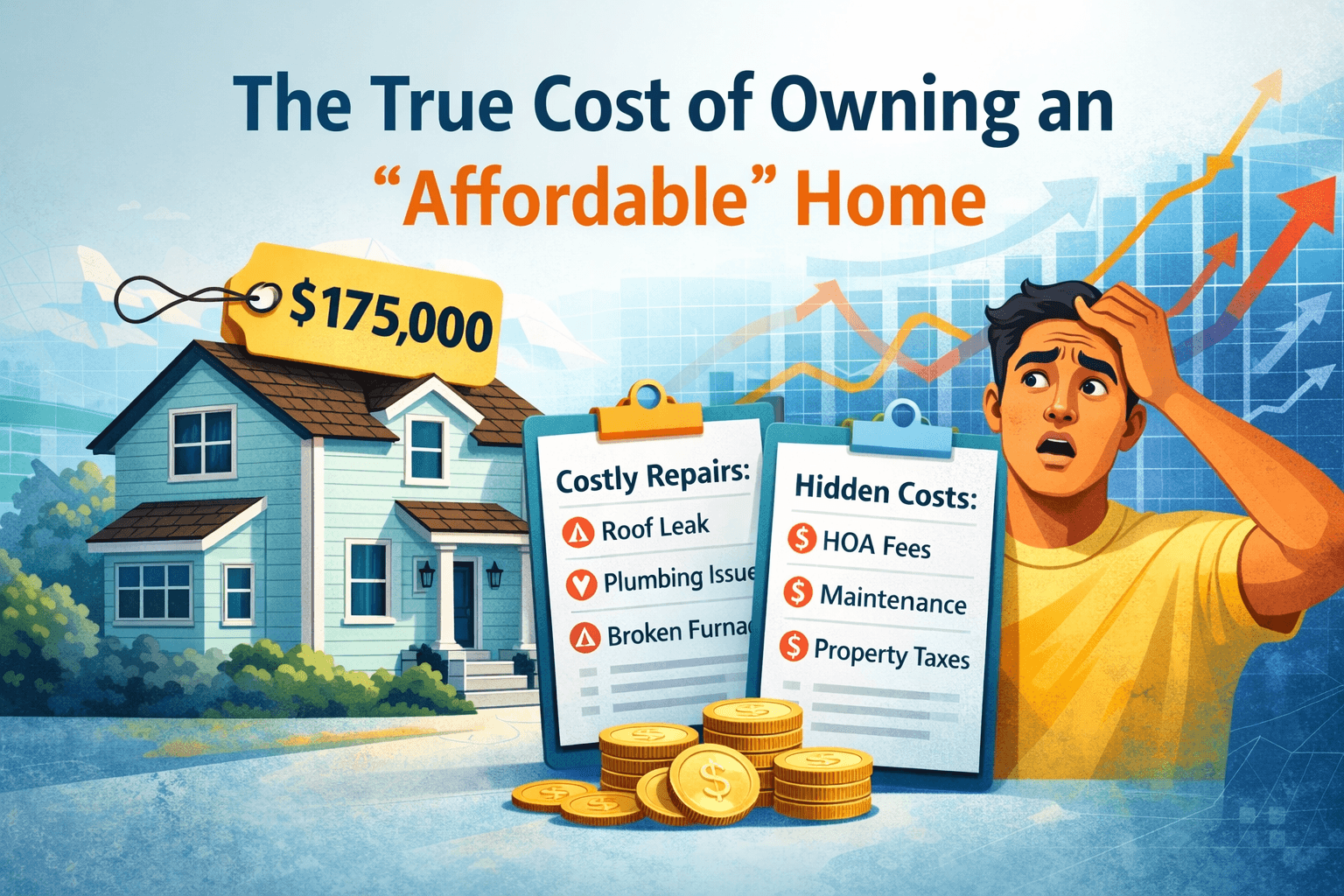
“Affordable” is one of the most misleading words in real estate.
Buyers usually mean it in terms of purchase price. Lower monthly payment. Lower upfront cost. A number that fits comfortably within a lender’s approval range. On paper, the home makes sense.
During inspections, though, we’re often looking at affordability through a very different lens—what the home will require after closing, not just what it costs to buy.
This is where many buyers get caught off guard.
Purchase Price and Ownership Cost Are Not the Same Thing
Two homes can sell for the same price and cost very different amounts to own.
We routinely inspect homes that were priced lower because:
- Major systems are near the end of their lifespan
- Maintenance has been deferred for years
- Repairs were postponed instead of addressed
- The home has design limitations that make fixes expensive
None of that is obvious from a listing price. And none of it necessarily makes the home a bad purchase. But it changes what “affordable” really means.
A Common Scenario We See
A buyer chooses the more affordable home in the neighborhood. It needs “a few things,” but nothing is actively broken. The inspection confirms that the roof is aging, the HVAC is original, the water heater is past its typical lifespan, and drainage could be improved.
Individually, none of these items feels overwhelming. Together, they create a near-term ownership reality where several expensive decisions are coming due at once.
That’s when affordability starts to feel different.
The house didn’t become expensive after closing. It was always carrying those costs—they just weren’t part of the purchase price.
Deferred Maintenance Is Often Baked Into the Price
Lower-priced homes often reflect deferred maintenance, whether buyers realize it or not.
When sellers delay replacing systems, maintaining drainage, or addressing wear, those costs don’t disappear. They shift forward in time. The next owner inherits them.
During inspections, we try to help buyers see this clearly—not to scare them, but to recalibrate expectations. A home that costs less upfront may require more cash flow later. A more expensive home may already have absorbed those costs.
Neither choice is wrong. But confusing one for the other leads to frustration.
Affordable Homes Often Have Less Margin for Error
Homes at the lower end of a price range often operate closer to their limits.
Older systems run longer cycles. Electrical systems are closer to capacity. Plumbing may be more fragile. Moisture control may be minimal.
When something fails in these homes, repairs tend to be more disruptive because there’s less redundancy and less tolerance built into the original design.
The cost isn’t just financial. It’s inconvenience, disruption, and stress.
Why Inspections Feel “Harsher” on Affordable Homes
Buyers sometimes feel like inspections are tougher on affordable homes than on higher-priced ones.
In reality, inspectors aren’t harsher—we’re seeing more accumulated wear in one place.
Affordable homes often haven’t had:
- Proactive system replacement
- Preventive maintenance
- Gradual upgrades over time
Instead, they’ve been kept functioning just enough. That works for a while. Eventually, time catches up.
Budgeting Beyond the Mortgage
One of the most important conversations we have with buyers happens when we shift from defects to planning.
Not “How much will this cost to fix today?” but:
- What will ownership likely require over the next few years?
- Which systems are nearing transition points?
- What happens if two or three things fail close together?
Buyers who think this way tend to have far better experiences—even in homes that need work.
Affordable Doesn’t Mean Unreasonable
It’s important to say this clearly: affordable homes can be great homes.
Some buyers are comfortable taking on deferred maintenance. Some want sweat equity. Some plan renovations and budget accordingly. For those buyers, affordability plus clarity is a win.
The problem arises when affordability is mistaken for simplicity.
A home that costs less upfront often requires more engagement from its owner. More planning. More attention. More patience.
How We Frame This at Upchurch Inspection
When we inspect homes that fall into this category, we focus less on labels and more on reality.
We explain:
- Where costs are likely to show up
- Which issues are manageable versus disruptive
- How timing affects ownership stress
Our goal isn’t to push buyers toward or away from a home. It’s to help them understand whether the version of “affordable” they’re buying matches the version they expect to live with.
An affordable home isn’t defined by price alone. It’s defined by how well its condition, maintenance history, and future needs align with a buyer’s resources and tolerance.
When those things line up, affordable homes can be some of the most rewarding to own. When they don’t, the gap usually shows up after closing—right when buyers least expect it.