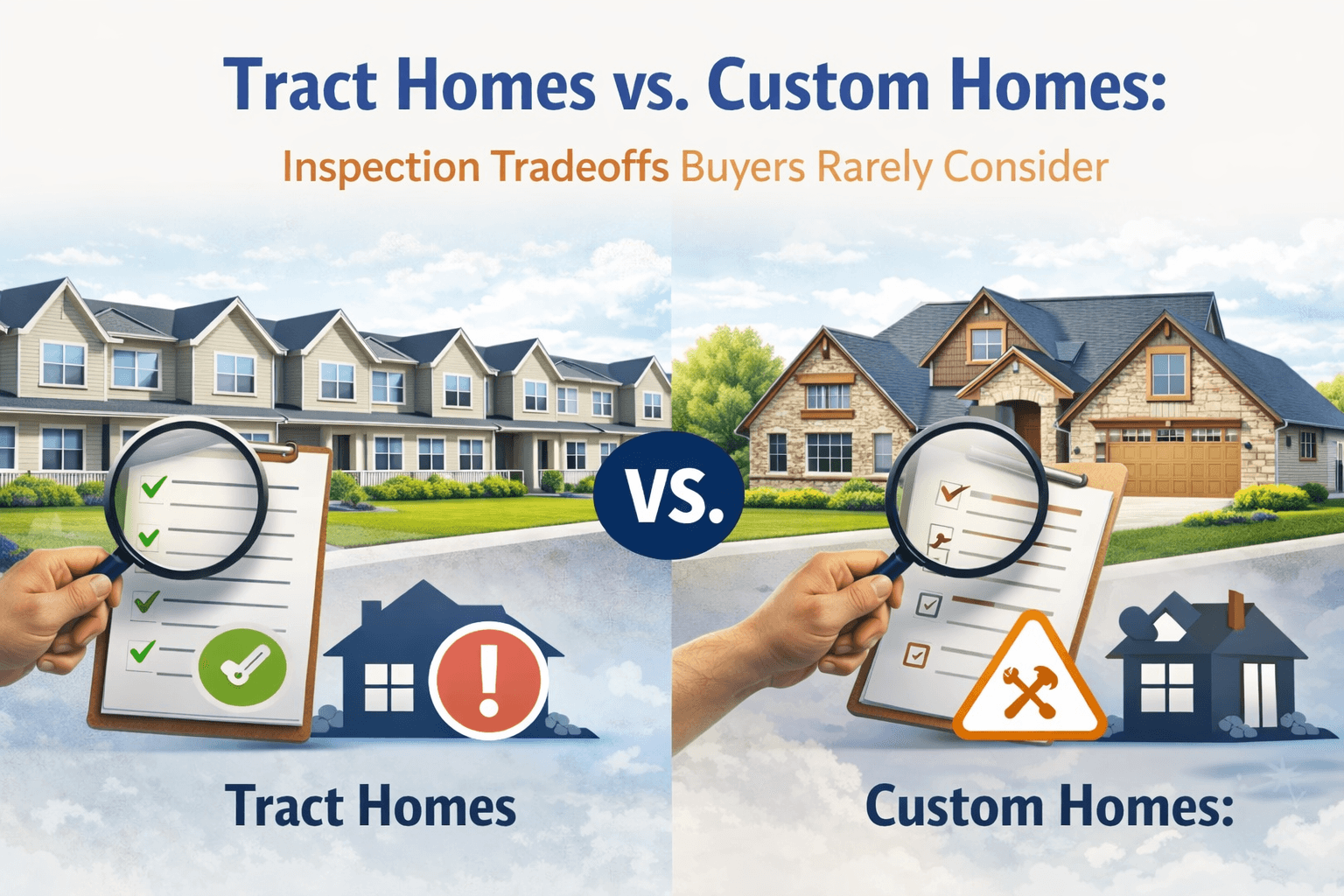
Buyers often describe homes as either “builder homes” or “custom homes,” and there’s usually an assumption baked into that language. Tract homes are seen as generic but safe. Custom homes are seen as higher quality and better built.
From an inspection standpoint, neither label tells the full story.
Both tract homes and custom homes have strengths. Both have weaknesses. And in many cases, the risks buyers encounter have less to do with the category and more to do with how decisions were made during construction and how the home has been maintained since.
Why Tract Homes Feel Predictable — and Why That Can Be Misleading
Tract homes are built in volume. The plans are standardized. Crews repeat the same work over and over. From a distance, that repetition feels reassuring.
In inspections, we do see benefits to that approach. Systems are familiar. Layouts are consistent. Many issues repeat across neighborhoods, which makes them easier to anticipate and evaluate.
The downside is that tract homes are often built to meet minimum standards as efficiently as possible. Materials are selected for cost and availability. Details that don’t affect resale appeal are often simplified.
Over time, this shows up as:
- Marginal drainage that was never revisited after initial grading
- HVAC systems sized “close enough” rather than optimized
- Structural components that perform adequately but lack redundancy
None of this means the home is defective. It means the margin for tolerance is smaller, especially as systems age.
Custom Homes Have Freedom — and That Cuts Both Ways
Custom homes benefit from flexibility. The design can respond to the lot. Materials can be upgraded. Systems can be tailored to how the home will be used.
When done well, this produces excellent results. We inspect custom homes that are thoughtfully designed, well-built, and still performing beautifully decades later.
But custom construction also introduces risk.
Because there’s no standard plan, everything depends on execution. We often see custom homes where:
- Structural elements were overcomplicated unnecessarily
- Unique designs created difficult-to-maintain areas
- Nonstandard materials aged unpredictably
- Repairs require specialized solutions
Custom doesn’t always mean better. Sometimes it means untested.
Consistency vs. Complexity
One of the biggest differences we see during inspections is consistency.
Tract homes tend to be consistent. If one system was installed a certain way, others usually were too. That makes future repairs more predictable.
Custom homes often show variation. One part of the house may be extremely well built, while another reflects compromise or experimentation.
From an inspection perspective, complexity increases uncertainty. More transitions, more custom details, and more unique assemblies mean more opportunities for things to go wrong over time.
Drainage and Site Design Matter More Than Labels
In both tract and custom homes, site conditions often matter more than construction type.
We’ve inspected tract homes with excellent drainage and custom homes with serious water problems. The difference is rarely the price point—it’s whether drainage, grading, and moisture movement were addressed thoughtfully from the beginning.
Homes that ignore water eventually pay for it, regardless of how they were marketed.
Repairs Tell the Truth Over Time
One of the clearest indicators of how a home was built is how it’s been repaired.
Tract homes often show straightforward repairs. Materials are standard. Solutions are familiar.
Custom homes sometimes show creative repairs that match the original creativity—sometimes well, sometimes not. When repairs start deviating significantly from original design intent, long-term performance can suffer.
We pay close attention to whether repairs feel compatible with the home or forced.
How Buyers Get Caught Off Guard
Buyers often assume:
- Tract homes are “cheap” but safe
- Custom homes are “premium” and worry-free
Reality is more nuanced.
A well-maintained tract home can outperform a poorly executed custom home. A thoughtfully designed custom home can outperform dozens of builder-grade houses.
The problem arises when buyers stop asking questions because the label feels reassuring.
How We Evaluate These Homes at Upchurch Inspection
When we inspect tract or custom homes, we don’t rely on category. We rely on performance.
We look at:
- How systems were sized and installed
- How the home manages water and moisture
- Where complexity introduces risk
- How the home has responded to age and use
We explain tradeoffs clearly, because no construction type is risk-free.
Tract homes and custom homes both work when expectations match reality.
A good inspection doesn’t tell buyers which category is better. It helps them understand what that category means for ownership, maintenance, and long-term cost—so they can decide whether the home in front of them fits their priorities, not just their preferences.