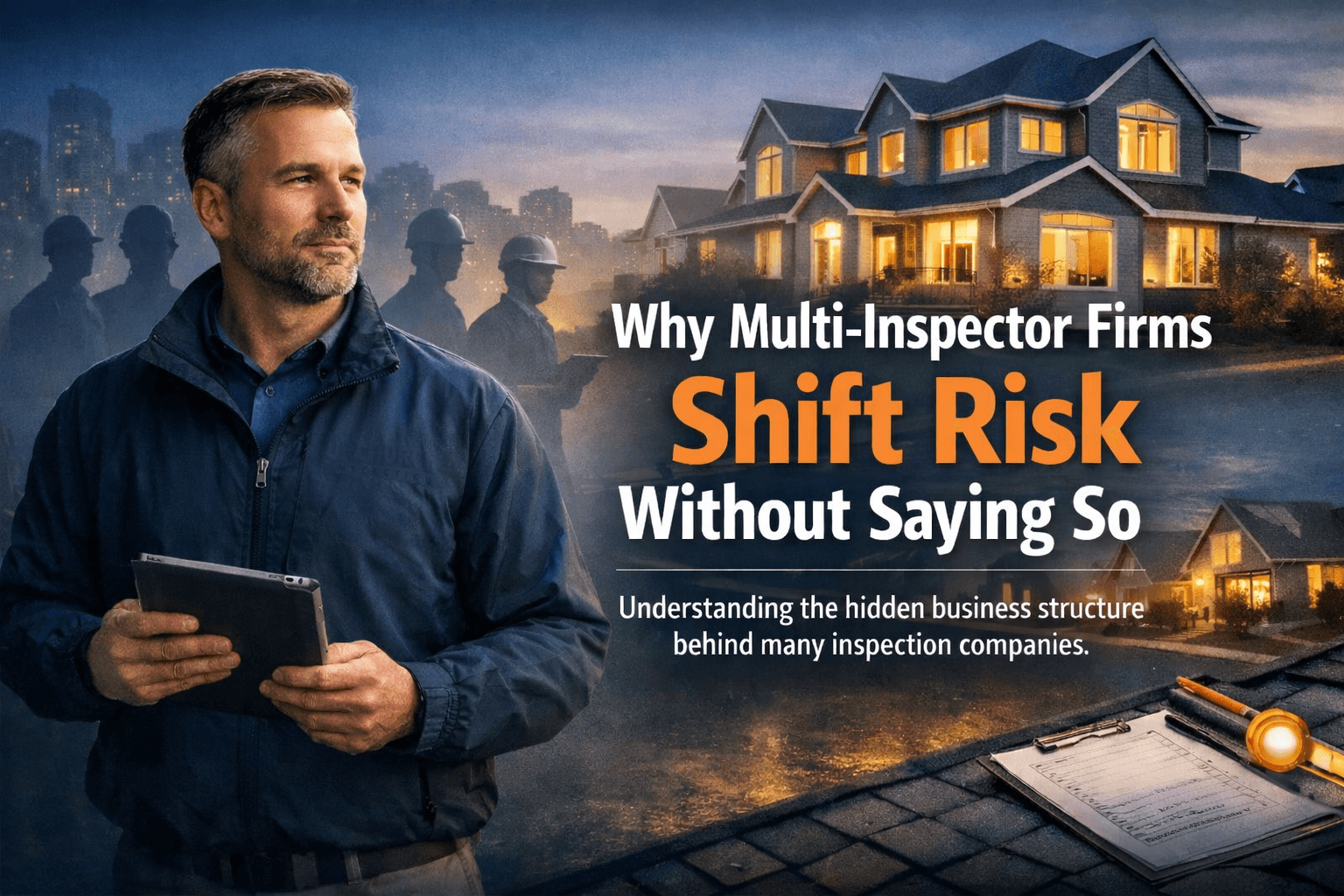
Most inspection companies don’t wake up one day and decide to push risk onto inspectors or clients. What happens instead is quieter and more gradual. As firms grow, add inspectors, and standardize operations, decisions get made in the name of efficiency that slowly relocate responsibility—often without anyone explicitly acknowledging that the shift has occurred.
The result is not usually unethical behavior. It is structural drift.
Growth Changes Where Risk Lives
In a small operation, risk is obvious and centralized. If an inspection goes poorly, the business owner feels it directly. Reputation, liability, and client trust are personal and immediate. There is little ambiguity about who owns the outcome.
As companies expand, that clarity blurs. Scheduling systems replace individual judgment. Policies replace case-by-case decisions. Compensation models are designed to smooth cash flow and protect the company from volatility. None of these choices are unreasonable on their own, but together they begin to move risk away from the organization and toward the people doing the work.
Inspectors still perform the inspections, but the consequences of dissatisfaction increasingly attach to them individually.
How the Shift Actually Happens
Risk does not move all at once. It migrates through small mechanisms that feel administrative rather than philosophical.
Pay structures begin to include penalties, clawbacks, or conditional compensation. Reviews and complaints are treated as financial events rather than quality signals. Schedules tighten to increase throughput. Independence is preserved on paper, while outcomes are tightly managed in practice.
Each change makes sense when viewed in isolation. Taken together, they create a system where inspectors absorb the cost of friction created by the transaction, even when that friction arises from honest reporting.
Why No One Says This Out Loud
Most leadership teams don’t frame these decisions as risk shifting, because that’s not how they experience them. From the top, these policies feel like safeguards—ways to stabilize the business, protect the brand, and manage growth responsibly.
From the field, they feel different. Inspectors experience risk as personal exposure: lost pay, increased scrutiny, reduced autonomy, or quiet removal from rotation. The same policy can feel like protection in one direction and pressure in the other.
That disconnect is why this issue is rarely discussed openly. Both sides believe they are acting reasonably within their roles.
The Downstream Effect on Inspections
When inspectors carry disproportionate risk, behavior changes—even among skilled, ethical professionals. Reports become more cautious. Language narrows. Recommendations are framed defensively. Not because inspectors stop caring, but because systems reward predictability more than judgment.
Clients rarely see this directly. They still receive reports. They still hear summaries. What they miss is the depth that never made it onto the page—the context that was shortened, the uncertainty that wasn’t fully explored, the risk that was softened to avoid downstream consequences.
Why This Matters More Than Scale
Large, multi-inspector firms can produce excellent work. Scale itself is not the problem. The issue is whether growth is paired with a clear decision about who absorbs risk when honesty creates friction.
If the answer is always “the inspector,” quality erodes quietly over time. If the company absorbs that risk—financially and culturally—professional judgment survives.
That choice determines whether inspections remain a professional service or become a standardized product.
The Choice We’ve Made
At Upchurch Inspection, we’ve been intentional about where risk lives. When an inspection is performed within scope, documented clearly, and communicated professionally, the outcome is owned by the company—not retroactively shifted to the inspector.
That doesn’t eliminate mistakes or complaints. It does preserve judgment. And judgment is the core of what inspections are supposed to provide.
Closing the Loop
Risk is always present in inspection work. The only real question is who carries it when the truth complicates a transaction. Multi-inspector firms don’t fail when they grow. They fail when growth decisions quietly answer that question without ever naming it.
Understanding that dynamic is not about criticism. It’s about clarity. And clarity is where better inspections—and better companies—begin.