
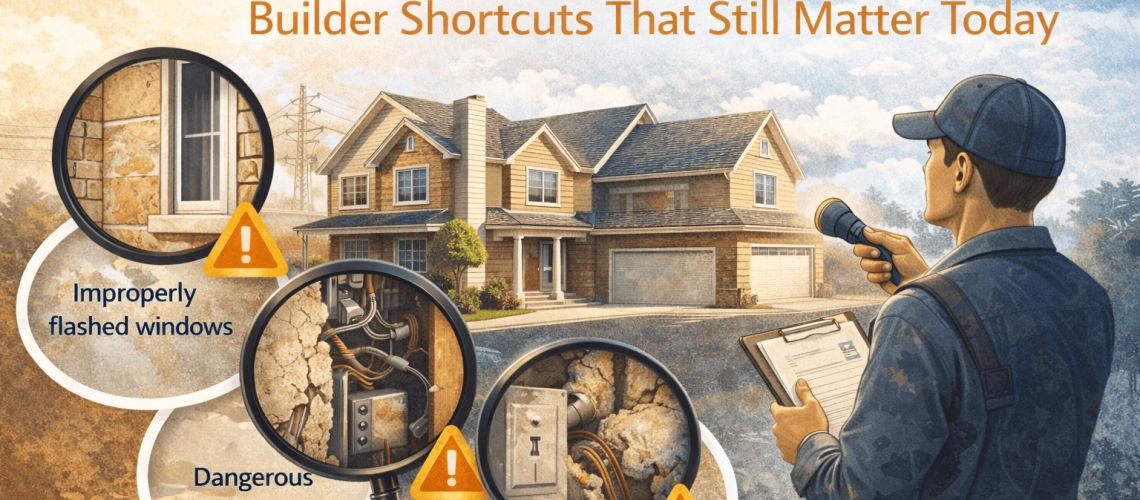
Homes built in the 1980s and 1990s often feel like a safe middle ground for buyers. They’re newer than mid-century homes, usually have more open layouts, and tend to look familiar. Many buyers assume that because these homes aren’t “old,” the inspection will be straightforward.
From experience, this is where expectations and reality often drift apart.
This period saw rapid suburban growth across West Tennessee, Middle Tennessee, Arkansas, and Southeast Missouri. Neighborhoods went up fast. Builders were under pressure to deliver volume, not longevity. Most of these homes are still standing and functioning—but many carry design and construction shortcuts that didn’t cause immediate problems and only became obvious years later.
Speed Started to Matter More Than Craft
By the 1980s and especially into the 1990s, residential construction became more standardized. That brought consistency, but it also introduced compromises.
We routinely see homes from this era where:
- Framing meets minimum standards but lacks redundancy
- Structural spans are pushed close to their limits
- Materials are thinner or lighter than earlier generations
None of this necessarily means the home is unsafe. It means the margin for error is smaller. When moisture, settlement, or deferred maintenance enters the picture, these homes tend to show stress sooner than buyers expect.
Drainage Was Often an Afterthought
One of the most consistent issues we see in 80s–90s homes is poor site drainage.
Many developments were graded quickly, with minimal attention to long-term water management. Over time, soil settles, landscaping changes, and drainage paths disappear.
The result is often:
- Water collecting near foundations
- Crawl spaces staying damp longer than intended
- Slabs experiencing subtle movement
Buyers often focus on the house itself and miss what’s happening around it. In our region, that’s a mistake. Drainage issues don’t stay outside. They migrate inward and downward.
Moisture Control Was Still Evolving
Modern moisture management wasn’t fully understood or implemented yet.
Homes from this era frequently lack:
- Proper vapor barriers
- Thoughtful crawl space ventilation
- Integrated moisture strategies
When these homes are updated—new windows, insulation, tighter building envelopes—the original moisture assumptions no longer hold.
We’ve inspected many 90s homes that look great on the surface but struggle with humidity issues that didn’t exist when the house was first built. The house changed. The moisture strategy didn’t.
Plumbing Choices That Didn’t Age Well
Plumbing materials used during this period are a recurring inspection topic.
We often find:
- Systems nearing the end of their expected lifespan
- Partial replacements that leave original piping in place
- Layouts that make future repairs invasive
These systems may still function fine during inspection, which makes the risk easy to discount. But once they fail, repairs are rarely small or simple.
The biggest surprise for buyers is usually not that plumbing fails—but how much disruption comes with fixing it.
Electrical Systems Were Sized for a Different Lifestyle
By the 80s and 90s, homes had more circuits and more outlets than earlier eras—but still far less demand than today’s households create.
We see homes where:
- Panels are original and heavily loaded
- Add-ons were done over time without holistic upgrades
- Grounding and bonding don’t reflect modern expectations
Everything may “work” during inspection. The risk lies in long-term stress and limited capacity, not immediate failure.
The Illusion of “Updated”
These homes are prime candidates for cosmetic renovation, and many have been updated one room at a time over decades.
New flooring, cabinets, fixtures, and lighting can make a home feel modern. But cosmetic updates don’t tell you what’s happening inside walls, under floors, or below the house.
One of the most common post-closing frustrations we hear comes from buyers who assumed “updated” meant “updated everywhere.”
How We Inspect 80s–90s Homes at Upchurch Inspection
When we inspect homes from this era, we don’t approach them with suspicion—we approach them with realism.
We look for:
- Where builders saved time or materials
- How the home has aged under regional conditions
- Whether updates addressed systems or just finishes
- How close major components are to transition points
We spend time explaining why a home that looks good can still require significant planning in the near future.
Homes built in the 1980s and 1990s aren’t bad homes. Many are solid, comfortable, and worth owning.
But they sit at a point in time where shortcuts made decades ago are finally showing their effects. A good inspection doesn’t judge those choices—it helps buyers understand what those choices mean now, before ownership makes them personal.