Frequently Asked Questions: Church Inspections
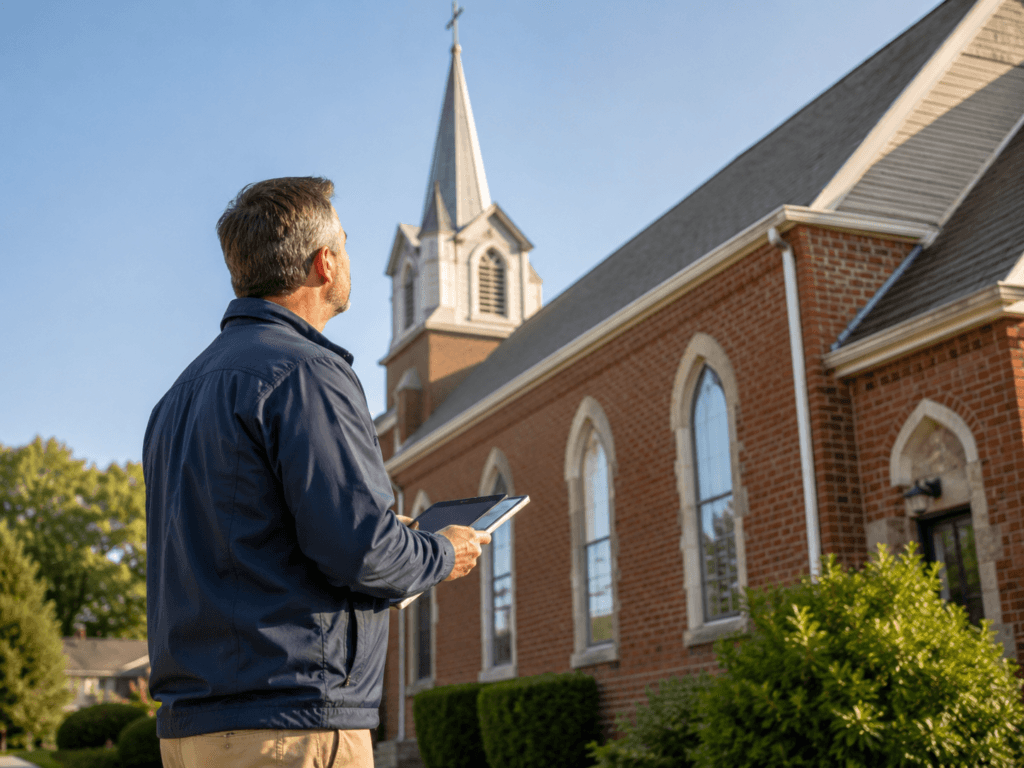
Church buildings can be complex, with sanctuaries, classrooms, kitchens, offices, mechanical areas, older additions, and long-term maintenance concerns.
Browse our frequently asked questions below to learn what a church property inspection may include, how PCA-style reviews work, and what boards, buyers, trustees, and congregations should know before making major property decisions.
Schedule Your Church Inspection
F.A.Q.
Frequently Asked Questions About Church Inspections
1. Church Inspection Basics
A church inspection is a visual, non-invasive evaluation of the visible and readily accessible components of a church property. Depending on the scope of the inspection, this may include the structure, roof, exterior, interior, electrical system, plumbing system, HVAC equipment, site drainage, restrooms, kitchens, classrooms, offices, fellowship areas, and other building components.
Church inspections are commonly performed when a congregation is buying a property, selling a property, refinancing, planning renovations, evaluating deferred maintenance, or trying to understand the condition of an aging facility.
Unlike a typical residential home inspection, a church inspection often involves larger buildings, more complex mechanical systems, public-use areas, assembly spaces, accessibility concerns, life-safety considerations, commercial-style electrical distribution, and long-term capital planning issues.
Churches need inspections because church buildings often contain hidden or deferred maintenance issues that can become expensive if they are not identified early.
Many churches operate on limited budgets. Repairs may be delayed, performed in phases, or handled by well-meaning volunteers. Over time, those choices can leave a building with roof leaks, drainage problems, aging HVAC equipment, outdated electrical components, plumbing concerns, moisture damage, foundation movement, or safety issues that may not be obvious during a casual walkthrough.
A professional church inspection gives decision-makers a clearer picture of the property before they commit to buying, selling, renovating, financing, or budgeting for repairs.
A church inspection is usually a type of commercial property inspection, but the scope should be adapted to the way church buildings are actually used.
Churches are different from office buildings, warehouses, retail spaces, and homes. They often include assembly spaces, classrooms, nurseries, kitchens, fellowship halls, administrative offices, storage rooms, mechanical areas, and exterior features such as parking lots, sidewalks, ramps, stairs, retaining walls, and drainage systems.
Because of that, the inspection should consider both building condition and practical use. A church board does not just need to know whether something is technically defective. They need to know what could affect safety, operations, future repairs, insurance concerns, accessibility, and long-term maintenance planning.
No. Church inspections are useful for buyers, sellers, existing congregations, boards, trustees, lenders, insurance discussions, renovation planning, and maintenance planning.
A buyer may need an inspection before purchasing a former church building. A congregation may need an inspection before listing its property for sale. A board may need a property condition review before approving a major renovation or capital campaign. A pastor or facilities committee may need an independent assessment before deciding how to prioritize repairs.
The inspection is not just about a real estate transaction. It is about understanding the building.
Older church buildings often have predictable patterns of deferred maintenance. Some of the most common issues include roof leaks, failed flashing, aging HVAC equipment, outdated electrical panels, insufficient outlets, plumbing leaks, deteriorated cast iron or galvanized piping, masonry cracks, wood rot, moisture intrusion, poor drainage, damaged flooring, plaster cracks, settlement concerns, and repairs that were never fully completed.
In many older churches, the building was not constructed all at once. A sanctuary may have been built first, then classrooms added later, then a fellowship hall, then office space, then kitchen or restroom updates. Each phase may have different construction methods, different rooflines, different electrical work, and different mechanical systems.
That patchwork history is one reason church inspections require careful attention. The problem is not always one major failure. Sometimes the risk comes from many small issues spread across a large building.
Toggle Content
Yes. Upchurch Inspection provides church property inspections for buyers, sellers, congregations, boards, trustees, and property decision-makers.
We inspect church buildings with a practical, risk-based approach. Our focus is on helping clients understand visible building conditions, major systems, deferred maintenance, safety concerns, and potential long-term repair issues.
Whether the property is a small rural church, an older historic church, a multi-building campus, or a former church being purchased for another use, the inspection should match the complexity of the building.
Upchurch Inspection can inspect a wide range of church and religious-use properties, including small rural churches, older historic churches, traditional sanctuaries, fellowship halls, classroom buildings, church offices, multi-building campuses, former church buildings, and properties being considered for religious, nonprofit, educational, or assembly use.
The scope should match the building. A small single-building church may need a straightforward commercial-style inspection, while a larger campus with multiple additions, kitchens, classrooms, mechanical areas, and older systems may require a more detailed PCA-style review.
2. Church Property Condition Reviews and Capital Planning
Not always.
A standard church inspection is usually a visual inspection focused on readily accessible building systems and visible concerns. A Property Condition Assessment, often called a PCA, is a more formal commercial due diligence process. A PCA-style review is typically focused on physical deficiencies, major building systems, immediate repair needs, short-term concerns, and potential capital expenses.
For larger churches, older church campuses, lender-related work, board-level decisions, or nonprofit property planning, a PCA-style church inspection may be more appropriate than a basic inspection. This type of scope can help the client better understand not only what is wrong, but what issues may affect the budget over the next several years.
A PCA-style inspection makes sense when the client needs a more detailed understanding of risk, repair priorities, and long-term building costs.
This may be appropriate when a church is buying a large property, evaluating an older campus, planning a capital campaign, preparing for major renovations, refinancing, working with a lender, selling a property, or trying to prioritize deferred maintenance.
A basic inspection may identify visible defects. A PCA-style review goes further by organizing the building around systems, risk, useful life, maintenance exposure, and likely future repair needs. For board members and committees, that format can be easier to discuss because it connects building conditions to planning decisions.
For a church property, PCA-style reporting means the inspection is approached more like a commercial due diligence review than a simple checklist.
That may include evaluation of major systems, identification of visible physical deficiencies, documentation of deferred maintenance, review of known repair history when available, discussion of immediate repair priorities, and attention to systems that may require capital planning.
The report may address roof systems, building envelope, structure, HVAC equipment, electrical systems, plumbing systems, site drainage, parking areas, interior conditions, life-safety observations, accessibility-related concerns, and specialty areas such as kitchens, classrooms, nurseries, baptistries, or mechanical rooms.
A PCA-style inspection does not mean every concealed condition is discovered. It also does not replace engineers, architects, contractors, fire marshals, environmental consultants, or code officials. But it can provide a stronger due diligence document for decision-makers.
Yes. One of the most valuable reasons to inspect a church property is budgeting.
Church boards and property committees often need to make decisions over several years, not just one transaction. A good inspection can help identify which issues are immediate safety concerns, which are maintenance items, which are aging systems to monitor, and which may become larger capital expenses.
For example, an older roof, multiple aging HVAC units, deteriorated drainage, old electrical panels, and plumbing problems may not all require replacement at the same time. But the church needs to know those issues exist so they can plan responsibly.
A church inspection can help turn vague concerns into a more organized maintenance and repair discussion. A PCA-style church inspection can be especially useful when the client needs to think in terms of short-term repairs, long-term capital reserves, and responsible stewardship of the property.
A standard inspection report identifies visible concerns and recommends appropriate next steps, but it is not the same as a contractor bid.
For larger church properties, a PCA-style scope may include general opinions of probable cost or repair priority discussions if specifically agreed to in the inspection scope. These are planning-level opinions, not guaranteed prices, contractor estimates, or bids.
For actual pricing, the church should obtain quotes from qualified contractors. The inspection helps identify what needs attention so the church can obtain more focused repair proposals.
A basic church inspection focuses on visible and readily accessible building components, including major systems, safety concerns, roof conditions, plumbing, electrical, HVAC, structure, interior areas, and exterior components.
A PCA-style church inspection is more detailed and is intended for clients who need a stronger due diligence or planning document. It looks at the property more like a commercial asset, with attention to physical deficiencies, deferred maintenance, major system condition, repair priorities, and potential long-term capital expenses.
For a small church, a basic inspection may be enough. For a larger church, older campus, lender-related review, board decision, or capital planning project, a PCA-style scope may be more appropriate.
Yes. One of the most useful parts of a church inspection is helping decision-makers separate urgent concerns from routine maintenance and long-term planning issues.
Some findings may involve immediate safety concerns, active leaks, electrical hazards, structural movement, or systems that need prompt evaluation. Other findings may be deferred maintenance items, aging systems, or conditions that should be monitored and planned for over time.
For boards, trustees, pastors, and property committees, this distinction matters. A good inspection should help the church understand what needs attention now, what should be budgeted for soon, and what can reasonably be planned as part of long-term facility stewardship.
Yes. A church inspection can be useful when leadership is preparing for a capital campaign, facilities plan, renovation discussion, or long-term maintenance strategy.
Churches often need to plan for major expenses such as roof replacement, HVAC upgrades, electrical improvements, plumbing repairs, accessibility improvements, restroom renovations, kitchen updates, drainage corrections, or deferred maintenance. An inspection can help the board, trustees, pastor, or facilities committee better understand the visible condition of the property before asking the congregation to support major repairs or improvements.
For larger churches or older campuses, a PCA-style review may be especially helpful because it can organize concerns around immediate needs, short-term priorities, and longer-term capital planning.
3. Major Building Systems
The exact scope depends on the property and the client’s needs, but a church inspection may include:
- Roof coverings, roof drainage, flashing, penetrations, and visible signs of leakage
- Exterior walls, trim, windows, doors, steps, railings, ramps, and walkways
- Foundation, visible structural components, framing, floors, walls, and ceilings
- Sanctuary, fellowship hall, offices, classrooms, restrooms, kitchens, and storage areas
- Electrical panels, visible wiring, outlets, lighting, grounding, and safety concerns
- Heating and cooling equipment, ductwork, visible distribution, and general system condition
- Plumbing fixtures, water supply piping, drainage piping, water heaters, and visible leaks
- Attics, crawlspaces, basements, mechanical rooms, and accessible utility spaces
- Parking areas, grading, drainage, exterior safety concerns, and site-related issues
For larger or more complex properties, the inspection may also include additional services or specialty evaluations such as sewer camera scoping, roof drainage evaluation, moisture investigation, environmental testing, or review by specialty contractors or engineers when needed.
Yes, the roof is one of the most important parts of a church inspection.
Church roofs can be complicated. Many church buildings have steep roof sections, flat or low-slope roof areas, older shingles, metal roofing, built-up roofing, modified bitumen, internal drains, scuppers, parapet walls, valleys, steeples, towers, dormers, chimneys, and multiple additions that create vulnerable transitions.
Roof problems can affect ceilings, insulation, framing, plaster, electrical components, interior finishes, and indoor air quality. In a church setting, roof leaks may go unnoticed if a section of the building is not used every day.
A church inspection should look for visible roof defects, signs of prior leaks, improper drainage, damaged flashing, deteriorated sealants, ponding water where visible, failing roof materials, and conditions that may warrant further evaluation by a qualified roofing contractor.
Yes, visible HVAC equipment is commonly included in a church inspection.
Church HVAC systems are often expensive and may include multiple split systems, package units, boilers, furnaces, rooftop units, mini-splits, hydronic heat, large duct runs, older controls, and equipment serving different parts of the building.
A major issue with church properties is uneven usage. Some areas may be conditioned regularly, while classrooms, offices, storage rooms, or fellowship halls may be used only at certain times. This can contribute to humidity problems, musty odors, comfort complaints, and hidden moisture issues.
The inspection should document visible equipment condition, approximate age where available, general operation when accessible and appropriate, visible damage, poor maintenance indicators, condensate concerns, and conditions that may require evaluation by an HVAC contractor.
Yes, visible and readily accessible electrical components are typically included in a church inspection.
Church electrical systems may include older service equipment, multiple panels, subpanels, added circuits, stage or sound equipment circuits, classroom wiring, kitchen circuits, exterior lighting, emergency lighting, exit signs, and wiring added during renovations.
Common electrical concerns in churches include outdated panels, missing covers, open junction boxes, improper wiring methods, overloaded circuits, double-tapped breakers, missing GFCI protection, ungrounded receptacles, damaged outlets, extension cord reliance, poor labeling, and evidence of amateur repairs.
The inspection does not replace a full electrical engineering evaluation or code compliance inspection, but it can identify visible safety concerns and conditions that should be evaluated or corrected by a licensed electrician.
Yes. Flat and low-slope roof areas can be included when they are visible and safely accessible.
Many church buildings have a combination of roof types. The main sanctuary may have a steep roof, while additions, classrooms, offices, fellowship halls, covered entries, or mechanical areas may have flat or low-slope roof sections. These areas can be vulnerable to ponding water, deteriorated seams, clogged drains, damaged flashing, failed sealants, parapet issues, roof penetrations, and leaks at transitions between different roof systems.
A church inspection can document visible concerns and recommend further evaluation by a qualified roofing contractor when roof conditions are beyond the inspection scope or require specialized assessment.
Yes, visible plumbing components are typically inspected.
Church plumbing systems may include public restrooms, kitchen fixtures, water heaters, janitor sinks, baptismal-related plumbing, hose bibbs, older supply piping, drain lines, and plumbing routed through crawlspaces, basements, walls, or ceilings.
Older church buildings may have cast iron drains, galvanized water lines, deteriorated shutoff valves, slow drains, leaking fixtures, unsupported piping, outdated water heaters, or prior repairs that were never properly finished.
For older properties, sewer line scoping may be worth considering as an additional service. A building can look acceptable inside while still having a buried sewer line problem that becomes expensive after purchase.
Visible kitchen components may be included, but the exact scope should be clearly defined.
Many churches have kitchens used for fellowship meals, events, daycare programs, outreach, or food service. Some kitchens are simple warming kitchens, while others may have commercial-style equipment, grease-producing appliances, hoods, fire suppression systems, large sinks, and specialized plumbing or electrical needs.
A standard inspection may observe visible plumbing, electrical, ventilation, appliances, surfaces, leaks, and general condition. However, commercial kitchen code compliance, fire suppression certification, health department requirements, and hood system performance may require specialty evaluation.
A sewer scope is strongly worth considering for older church properties, especially where the building has old cast iron, clay, Orangeburg, or unknown buried drainage piping.
Churches often have large restroom groups, kitchens, fellowship halls, and public-use plumbing. If the sewer line fails, the repair can be disruptive and expensive. In older properties, buried piping may have root intrusion, offsets, separated joints, corrosion, bellies, blockages, or collapse.
A sewer camera inspection is not always included in a standard church inspection, but it can be added when access is available and the client wants a better understanding of underground drainage risk.
Yes, visible site and exterior components can be included in a church inspection. This may include parking areas, sidewalks, exterior stairs, ramps, railings, walkways, grading, drainage, retaining walls, exterior lighting, and general site safety concerns.
These areas are important because churches are public-use properties. Trip hazards, deteriorated pavement, poor drainage, unsafe stairs, missing handrails, steep transitions, or water flowing toward the building can create safety concerns and expensive maintenance issues.
A standard inspection does not replace a full civil engineering review, paving contractor evaluation, or formal accessibility audit, but visible concerns can be documented and referred for further evaluation when needed.
Yes, readily accessible crawlspaces, basements, attics, and mechanical rooms may be included in the inspection scope.
These areas often reveal some of the most important conditions in a church building, including moisture intrusion, structural concerns, outdated wiring, plumbing leaks, HVAC equipment issues, insulation problems, ventilation concerns, foundation movement, wood deterioration, and evidence of prior repairs.
Access is important. If these areas are locked, blocked, unsafe, too small to enter, or otherwise inaccessible, the limitation should be documented in the report. In some cases, follow-up access may be recommended because hidden utility spaces can contain major building information.
4. Church-Specific Spaces and Features
Yes, visible classroom, nursery, daycare, and children’s ministry areas can be included in the inspection scope. The inspection may identify visible safety concerns, electrical issues, moisture damage, damaged finishes, plumbing concerns, trip hazards, or general building defects. However, licensing compliance for daycare, school, or child-care operations may require review by the appropriate regulatory authority.
Visible and readily accessible portions of steeples, bell towers, and similar features may be observed as part of the inspection, but these areas often have limitations.
Steeples and towers can involve height, concealed framing, specialty materials, lightning protection, difficult access, and structural concerns that are beyond a standard visual inspection. Obvious deterioration, damaged cladding, open seams, staining, leaning, moisture damage, or visible movement may be documented when observed.
However, a full steeple or bell tower evaluation may require a structural engineer, roofing contractor, specialty contractor, drone evaluation, lift access, or other specialized assessment.
Playground equipment may be visually observed as a courtesy if requested, but a standard church property inspection is not the same as a certified playground safety inspection. If playground safety compliance is a major concern, a specialized playground safety evaluation should be obtained.
Visible and accessible baptismal areas may be observed as part of the inspection, including signs of leakage, moisture damage, plumbing concerns, access issues, and visible finishes. However, concealed waterproofing, hidden plumbing, and specialty equipment may require further evaluation if concerns are observed.
Built-in electrical components and visible safety concerns may be observed, but a standard church inspection does not fully evaluate sound systems, projection systems, stage lighting, livestream equipment, control boards, speakers, or low-voltage media systems for performance. Specialty AV systems should be reviewed by a qualified low-voltage or audio/video contractor if performance or capacity is a concern.
Stained glass windows may be visually observed for obvious damage, deterioration, leakage, loose panels, failed protective glazing, or related moisture concerns. However, full restoration assessment, structural evaluation of stained glass assemblies, or valuation should be performed by a qualified stained glass specialist.
5. Safety, Accessibility, and Environmental Concerns
A church inspection may identify visible accessibility-related concerns, but it is not the same as a full ADA compliance audit unless that service is specifically included in the scope.
Church properties often have ramps, stairs, handrails, restrooms, door thresholds, parking areas, sidewalks, and seating arrangements that affect accessibility. The inspection may document obvious concerns, such as damaged ramps, missing handrails, steep transitions, trip hazards, deteriorated walkways, or restrooms that appear difficult to access.
However, formal accessibility compliance involves detailed measurements, legal standards, and use-specific requirements. If accessibility compliance is a major concern, the church should request a dedicated accessibility evaluation.
A standard church inspection may observe visible fire safety components, but it does not replace a fire marshal inspection, fire alarm inspection, sprinkler inspection, hood suppression inspection, or life-safety code evaluation.
Visible items such as exit signs, emergency lights, fire extinguishers, obvious blocked exits, damaged doors, and general egress concerns may be noted. However, testing and certification of alarm systems, sprinkler systems, fire suppression systems, and emergency systems should be performed by qualified specialists.
For church properties, this distinction matters. A building can have visible fire safety equipment, but that does not mean the equipment is current, tested, certified, or compliant for the building’s use.
A standard church inspection is not an environmental inspection and does not confirm the presence or absence of mold, asbestos, lead-based paint, radon, hazardous materials, indoor air quality issues, or other environmental hazards unless those services are specifically added.
Older church buildings may contain materials that warrant further evaluation, especially before renovation, demolition, or major repairs. Suspect materials may include old flooring, pipe insulation, ceiling materials, textured surfaces, old paint, boiler insulation, or other materials commonly found in older buildings.
If environmental concerns are present, additional testing or evaluation by qualified environmental professionals may be recommended.
Yes. Historic and older church buildings often require a more careful inspection approach because they may include older framing, masonry, plaster, stained glass, wood windows, outdated wiring, aging plumbing, modified rooflines, and repairs performed over many decades. The inspection focuses on visible condition, functional concerns, moisture risk, safety issues, and areas where specialty evaluation may be needed.
Visible emergency exits and means of egress may be observed as part of the inspection. This may include exit doors, exit pathways, stairways, corridors, exterior discharge areas, obvious obstructions, damaged doors, missing or damaged hardware, and visible concerns that could affect safe movement out of the building.
However, a church inspection is not the same as a full life-safety code inspection, fire marshal inspection, or occupancy compliance review. Churches and assembly buildings can have specific requirements based on use, occupant load, layout, and local authority requirements.
If egress, fire safety, or occupancy compliance is a major concern, the church should consult the appropriate fire official, code professional, architect, or life-safety specialist.
Toggle Con
Yes. Visible moisture damage and signs of water intrusion are important parts of a church inspection.
This may include ceiling stains, wall stains, damaged plaster, soft or deteriorated materials, musty odors, evidence of roof leaks, crawlspace moisture, basement seepage, foundation water entry, damaged flooring, swollen trim, deteriorated wood, poor drainage, or staining around windows and doors.
Moisture is one of the biggest long-term threats to older church buildings. It can affect finishes, framing, electrical components, indoor air quality, and the overall maintenance cost of the property. A standard inspection can document visible moisture indicators, but concealed moisture conditions, mold testing, environmental testing, and destructive investigation are separate services unless specifically included.
tent
6. Buying, Selling, and Ownership Situations
Yes, but the inspection does not make the decision for you.
The inspector’s role is to document visible conditions, explain concerns, identify risk, and recommend appropriate next steps. The buyer, board, trustees, lender, or property committee must decide whether the property still makes sense based on the inspection findings, budget, negotiations, financing, ministry goals, and tolerance for repair risk.
A church inspection is not a pass/fail test. It is a due diligence tool.
Yes. In some cases, a preliminary walkthrough or consultation may help a church understand whether the property has obvious concerns before moving deeper into negotiations.
A preliminary review is not a substitute for a full inspection, but it can help identify major visible red flags early. This may be useful when a congregation is considering multiple properties or does not want to spend time and money pursuing a building that already shows significant visible risk.
Yes. Many church inspections are not related to a purchase at all.
Existing congregations may request an inspection to evaluate deferred maintenance, prepare for a capital campaign, plan repairs, review an older building, document current conditions, or help the board understand which issues should be addressed first.
For churches that have owned a building for decades, an independent inspection can be useful because leadership may be accustomed to conditions that an outside inspector sees differently.
Yes. A church should strongly consider an inspection before buying a building.
Church buildings can carry major financial risk. A congregation may be excited about a sanctuary, location, or opportunity for ministry, but the property may have roof problems, HVAC costs, drainage issues, electrical concerns, plumbing defects, accessibility challenges, or structural repairs that affect the true cost of ownership.
An inspection helps the church make a more informed decision before committing to the property.
Yes. A pre-listing inspection can help a church understand the condition of the property before it goes on the market.
This can reduce surprises during negotiations, help leadership set realistic expectations, and allow the church to decide whether to repair certain items, disclose known conditions, or price the property accordingly.
For older church properties, a pre-listing inspection can also help identify issues that may concern buyers, lenders, or investors.
A church inspection report may help document the visible condition of the property for internal planning, buyer due diligence, board discussions, lenders, insurance conversations, or other decision-makers.
However, insurance companies and lenders set their own requirements. Some may require specific forms, specialist evaluations, environmental reports, roof certifications, fire safety inspections, or engineering opinions. A church inspection can support the due diligence process, but it does not guarantee that an insurer or lender will accept the report for every purpose.
If the inspection is being requested for lender or insurance reasons, the client should provide those requirements before the inspection so the scope can be discussed up front.
Yes. A church inspection before renovation can help identify visible building conditions that may affect the project scope, budget, or priorities.
This can be useful before renovating a sanctuary, fellowship hall, kitchen, classroom area, restroom group, office area, roof system, HVAC system, or older addition. The inspection may identify moisture concerns, electrical limitations, plumbing issues, structural observations, drainage problems, or deferred maintenance that should be considered before work begins.
A pre-renovation inspection does not replace architectural design, engineering, permitting, contractor planning, or environmental testing, but it can help the church better understand the existing building before committing to improvements.
7. Pricing, Timing, and Scheduling
Church inspection pricing depends on the size, age, complexity, and scope of the property.
A small church building may be priced differently than a multi-building campus with classrooms, fellowship halls, commercial kitchens, multiple HVAC systems, crawlspaces, attics, or older additions. Pricing may also be affected by roof access, travel, reporting requirements, requested ancillary services, and whether the client wants a basic inspection or PCA-style review.
We price church inspections based on the time required to properly inspect and document the property, not by treating the building like a basic residential inspection.
The time required depends on the size, age, complexity, accessibility, and scope of the property.
A small church may take a few hours. A larger church campus with multiple buildings, older systems, multiple roof sections, classrooms, fellowship areas, kitchens, crawlspaces, attics, basements, or mechanical rooms may take significantly longer (sometimes several days).
Older church properties should not be rushed. The inspection needs enough time to evaluate major systems, document visible concerns, take photographs, and understand how the building is put together.
Report timing depends on the size and complexity of the property, the scope of the inspection, and whether any specialty services or additional documentation are involved.
For smaller church inspections, the report may be available relatively quickly. Larger church properties, older buildings, multi-building campuses, PCA-style reviews, and inspections with extensive photo documentation may require additional report preparation time.
The expected report delivery timeframe should be discussed before the inspection so the church, buyer, board, lender, or property committee knows what to expect.
A church inspection report should be clear, photo-based, and organized around the condition of the property.
The report should document significant visible defects, safety concerns, deferred maintenance, aging systems, moisture issues, roof concerns, structural observations, electrical and plumbing concerns, HVAC issues, and items that may require further evaluation. It should also explain limitations, inaccessible areas, and conditions that were outside the scope of the inspection.
The best reports do more than list defects. They help the client understand risk, priority, and next steps.
Before a church inspection, it helps to provide available information about the property, including building age, known additions, prior inspection reports, roof repair history, HVAC maintenance records, known leaks, moisture issues, electrical upgrades, plumbing repairs, sewer repairs, renovation history, current use, areas of special concern, and access instructions.
Access is especially important. Locked rooms, attics, crawlspaces, basements, roof areas, mechanical rooms, electrical rooms, storage areas, and utility spaces may contain important information about the condition of the building.
The more information available before the inspection, the better the inspector can understand the property and focus attention where it matters most.
Yes. Access is very important for a thorough church inspection.
Church buildings often have locked rooms, storage closets, mechanical rooms, electrical rooms, attics, crawlspaces, basements, boiler rooms, sound booths, classrooms, offices, kitchens, and utility areas that contain important building systems. If these areas are locked, blocked, unsafe, or inaccessible, the inspection may be limited.
Before the inspection, it is best to make sure keys are available, stored items are moved away from major equipment where practical, and someone familiar with the building can provide access to utility spaces. If important areas cannot be inspected, those limitations should be documented in the report, and follow-up access may be recommended.
If some areas are inaccessible, those limitations should be documented in the inspection report.
Common access limitations in church buildings include locked mechanical rooms, blocked storage areas, inaccessible attics, unsafe crawlspaces, roof areas that cannot be safely accessed, electrical rooms without keys, rooms filled with stored items, or areas concealed by finishes.
Inaccessible areas matter because they may contain important building systems or hidden defects. If a significant area cannot be inspected, follow-up access may be recommended. The inspection report can only address visible and accessible conditions at the time of the inspection.
For a church property, it can be helpful for one or two decision-makers to attend part of the inspection, especially near the end.
This may include a pastor, trustee, board member, facilities manager, buyer, or property committee representative. However, too many people on site can slow the inspection and create confusion. The inspector needs time to inspect carefully, document findings, and stay focused.
A final walkthrough or summary discussion is often more useful than having a large group follow the inspector throughout the entire inspection.
For larger church properties or board-directed inspections, a follow-up consultation may be available to help explain the report, discuss priorities, and answer questions from decision-makers.
This can be helpful when multiple trustees, pastors, board members, or committee members are involved. A church inspection report can contain a lot of information, and a follow-up discussion may help leadership understand which issues are urgent, which are maintenance-related, and which may require further contractor evaluation.
No. A church inspection does not guarantee that the building has no problems.
Inspections are visual and non-invasive. Inspectors do not open walls, dismantle systems, excavate buried piping, move stored contents extensively, or see hidden conditions behind finishes. Some defects are concealed, intermittent, inaccessible, or not active at the time of inspection.
The purpose of the inspection is to reduce uncertainty, not eliminate every possible risk. A good inspection gives the client a much better understanding of visible conditions and areas where further evaluation may be needed.
Need A Church Inspected?
Schedule Your Inspection Today
Before a church is purchased, sold, renovated, financed, or placed into a long-term facilities plan, the building deserves a careful look.
Upchurch Inspection provides professional church property inspections for buyers, congregations, pastors, trustees, boards, lenders, and property committees. We inspect visible and accessible building components, document significant concerns, and help decision-makers better understand the condition of the property before moving forward.
If you are evaluating a church building, former church property, historic church, rural church, or multi-building campus, contact Upchurch Inspection to discuss the scope, size, age, and specific concerns involved.
Call Upchurch Inspection: (901) 350-8885