Executive Summary
Commercial buildings in the Mid-South often carry risk long before they appear visibly distressed. A property may be occupied, marketable, and operational while still carrying roof, HVAC, drainage, plumbing, electrical, slab, site, or deferred-maintenance conditions that can become expensive after closing.
This report is an original field-based analysis from Upchurch Inspection, derived from field experience across 750+ property inspections, including residential, commercial, multifamily, institutional, mixed-use, and larger-property assessments. Commercial risk categories are interpreted through the lens of ASTM E2018-24 Property Condition Assessment methodology and recurring due diligence issues observed in Mid-South buildings. ASTM E2018-24 provides a framework for commercial Property Condition Assessments, including walk-through surveys, document reviews, interviews, and the identification of physical deficiencies. (ASTM International | ASTM)
Three findings drive this report:
1. Water management is the dominant regional risk multiplier.
In the Mid-South, roof drainage, parking lot runoff, poor grading, clogged drains, short downspouts, and site drainage defects often connect to broader building concerns. Water does not stay in one category. It affects roofs, pavement, foundations, slabs, crawlspaces, exterior walls, interior finishes, and long-term maintenance costs.
2. “Functional today” does not mean “low risk.”
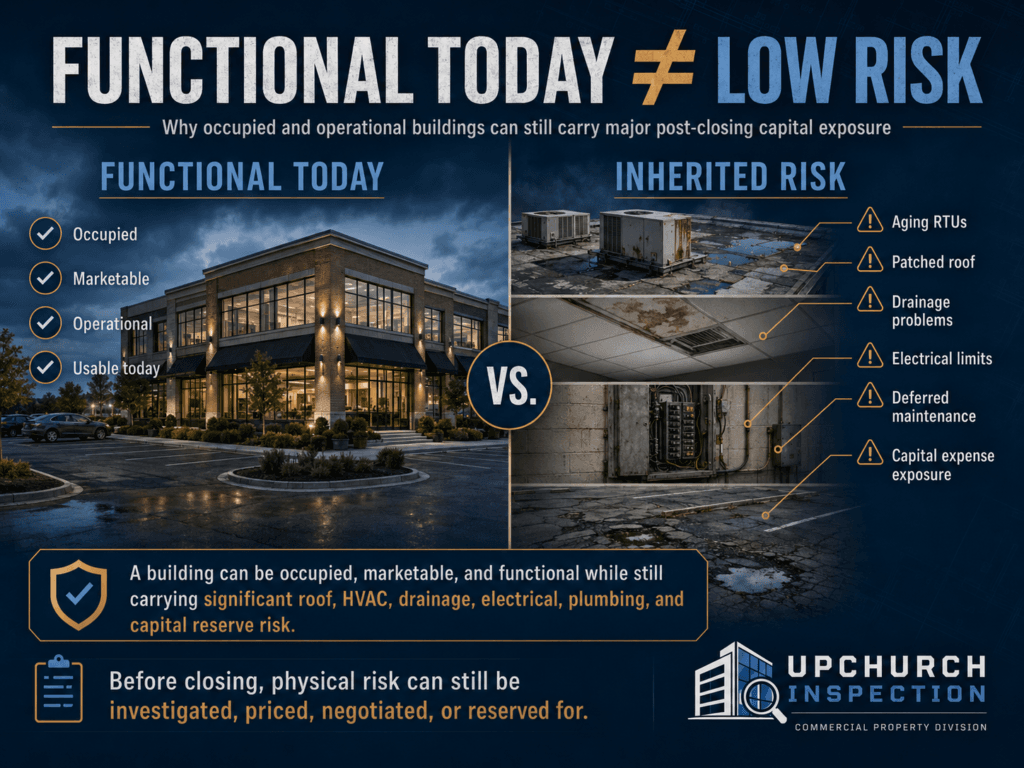
Many commercial buildings remain occupied and operational while carrying major capital exposure. Aging rooftop HVAC units, patched roof systems, deteriorated parking lots, older electrical panels, repeated plumbing repairs, and deferred exterior maintenance may not stop current use, but they can create significant ownership costs after closing.
3. Deferred maintenance is often more important than any single defect.
The most expensive properties are not always the ones with one dramatic failure. They are often the buildings where every system has been pushed just far enough to become the next owner’s problem. A strong commercial inspection or Property Condition Assessment should identify those patterns before the buyer loses leverage.
The purpose of this report is not to kill deals. It is to help commercial clients understand the deal before the roof, HVAC systems, drainage issues, electrical limitations, plumbing patterns, slab concerns, and deferred maintenance become their responsibility.
Key Findings
- Water management is the most consistent risk multiplier in Mid-South commercial buildings, affecting roofs, drainage systems, paved areas, foundations, slabs, crawlspaces, and exterior envelopes.
- Roof and HVAC concerns often create the largest near-term capital exposure, especially when low-slope roof systems, aging rooftop units, poor drainage, and missing maintenance records appear together.
- Deferred maintenance usually appears as a pattern, not a single defect. Patchwork roof repairs, dirty HVAC equipment, repeated plumbing stains, deteriorated sealants, cracked pavement, and missing records often tell the real story of how a property has been operated.
- Site drainage and parking lot conditions are often underestimated during commercial due diligence, even though pavement failure, ponding water, trip hazards, loading-area problems, and runoff can become major ownership issues.
- Intended use matters. A building that worked for one owner or tenant may not support the next buyer’s plan without electrical, mechanical, plumbing, access, safety, or structural upgrades.
- Commercial reports should support decision-making for people who were not present at the inspection, including buyers, lenders, attorneys, trustees, investors, boards, brokers, property managers, and facility decision-makers.
Who This Report Is For
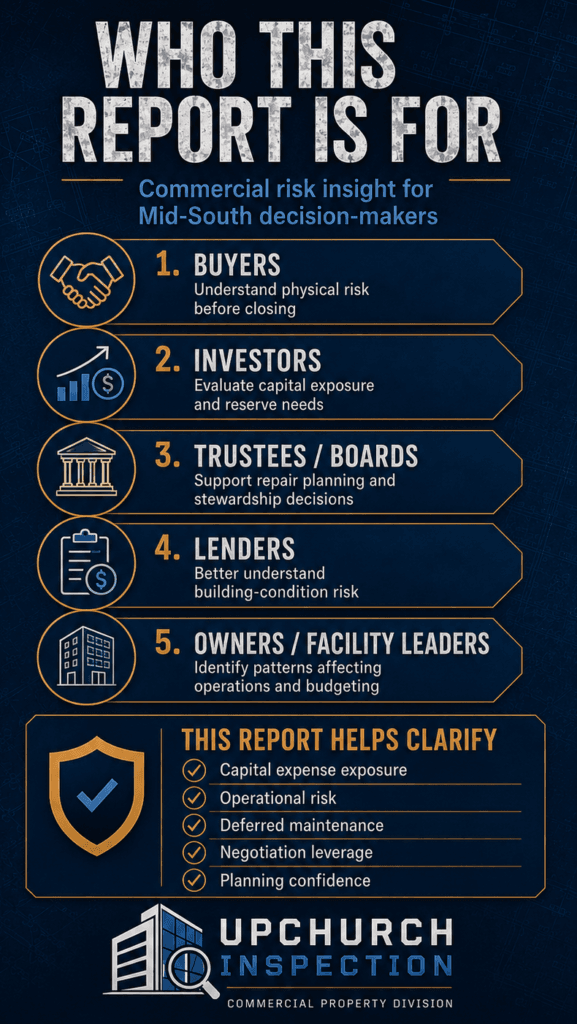
This report is intended for commercial buyers, investors, lenders, attorneys, brokers, trustees, church boards, property managers, business owners, facility decision-makers, and others evaluating commercial property in the Mid-South.
It is especially relevant for people involved in the purchase, financing, management, or long-term planning of commercial buildings, churches and campuses, warehouses and industrial properties, multifamily buildings, office and retail spaces, medical and daycare facilities, mixed-use properties, older renovated buildings, properties with visible deferred maintenance, and assets requiring board, lender, or investor review.
The report is written for decision-makers who need more than a basic defect list. It is intended to help readers understand how visible building conditions can become financial, operational, and capital-planning concerns after closing.
Methodology Disclosure
This report is an original field-based analysis prepared by Upchurch Inspection. It is not a statistical survey of every commercial building in the Mid-South and should not be interpreted as a peer-reviewed academic study.
The analysis is derived from Upchurch Inspection’s field experience across 750+ property inspections, including residential, commercial, multifamily, institutional, mixed-use, and larger-property assessments. Commercial findings are interpreted through the lens of ASTM E2018-24 Property Condition Assessment methodology, visible inspection-report patterns, and recurring due diligence issues observed in Mid-South buildings.
ASTM E2018-24 is a recognized commercial real estate due diligence framework for baseline Property Condition Assessments. The standard describes walk-through surveys to identify physical deficiencies, along with document reviews, research, and interviews to better understand the property and identify physical deficiencies. (ASTM International | ASTM)
Outside sources are used for regional context, including climate, stormwater behavior, soil conditions, seismic risk, commercial market activity, and commercial building system lifecycle considerations. The report is intended to help buyers, investors, trustees, lenders, and property owners better understand common physical-risk categories before closing or major investment.
What This Report Is Not
This report is a general field-based commercial property risk analysis. It is not a substitute for a property-specific commercial inspection, Property Condition Assessment, structural engineering evaluation, environmental assessment, code compliance inspection, fire marshal review, ADA compliance audit, roof certification, contractor estimate, legal advice, financial advice, or engineering opinion.
Every commercial property is different. Site-specific conditions should be evaluated by qualified professionals based on the property type, scope of work, intended use, transaction requirements, and visible conditions present at the time of evaluation.
The purpose of this report is to identify common commercial property risk categories and help buyers, investors, trustees, lenders, and property owners better understand where further due diligence may be needed.
Introduction: Commercial Buildings Fail Financially Before They Fail Physically
Commercial buildings often fail financially before they fail physically.
That is the central idea behind this report.
A commercial property does not have to be falling apart to carry serious risk. It can be occupied, marketable, income-producing, and functional during a showing while still hiding major capital exposure. A roof may not be leaking today, but it may be near the end of its practical life. Rooftop HVAC units may be running, but several may be aging together. A parking lot may still be usable, but drainage and pavement failure may already be creating the next major expense. Plumbing may work well enough during a walkthrough, but repeated stains, patched repairs, and old water heaters may tell a different story. Electrical service may power the current use, but not the buyer’s intended use.
That is why commercial due diligence has to look beyond whether the building appears usable.
The better question is:
What physical risk is the buyer inheriting, and what could that risk cost after closing?
For commercial buyers, investors, trustees, lenders, and property owners, the building is not just a structure. It is an asset. It supports income, operations, tenants, employees, customers, patients, congregation members, students, inventory, equipment, or organizational mission. When a major system fails, the impact is not limited to repair cost. It can affect business continuity, tenant satisfaction, lender confidence, insurance questions, board decisions, capital reserves, and long-term ownership.
A residential buyer may want to know whether the home is safe, functional, and reasonably maintained. A commercial buyer may need to answer a much larger set of questions. Can the property support the intended business use? Are the major systems approaching replacement? Is there enough documentation to understand maintenance history? Are there conditions that could affect tenants, operations, financing, insurance, or a board vote? Are the apparent defects isolated, or do they suggest a long pattern of deferred maintenance?
At Upchurch Inspection, we view commercial inspections and Property Condition Assessments as risk-management tools. The goal is not simply to find defects. Every building has defects. The goal is to help clients understand which conditions matter, which systems may require further evaluation, where deferred maintenance is showing up, and what physical concerns may become financial obligations after closing.
Before closing, risk can still be investigated, priced, negotiated, credited, reserved for, or rejected.
After closing, it becomes the buyer’s problem.
That is the difference.
A building that looks like an opportunity during the showing may still become a financial headache if the buyer does not understand the roof, HVAC, drainage, plumbing, electrical, site, slab, exterior envelope, and maintenance history. This report is meant to identify the commercial property conditions that most often deserve closer attention in the Mid-South and explain why they matter before the decision is final.
Why Commercial Property Risk Is Different
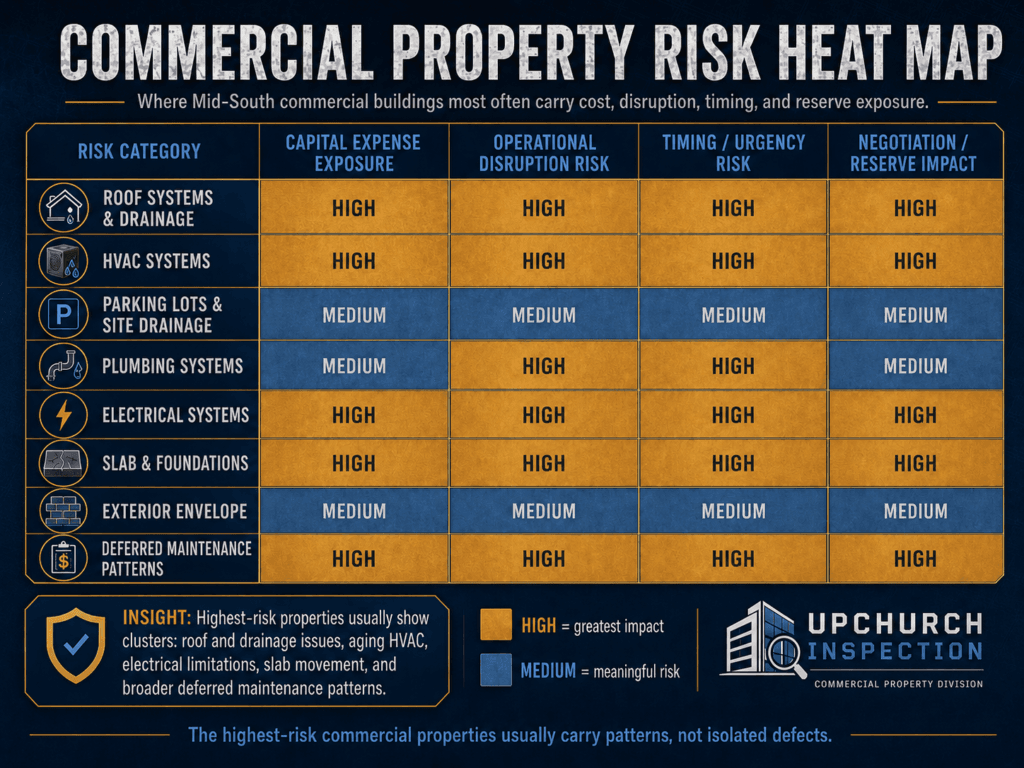
A commercial inspection is not just a larger home inspection.
The building may have some of the same basic systems: roof, structure, exterior, plumbing, electrical, HVAC, interior spaces, drainage, and safety concerns. But the meaning of those systems changes in a commercial setting.
In a house, a roof leak may affect a bedroom ceiling. In a commercial building, a roof leak may damage tenant space, stored inventory, electrical components, medical records, classrooms, retail merchandise, or church sanctuary finishes. In a house, an aging HVAC system may be a comfort and replacement-cost issue. In a commercial building, several aging rooftop units may create a capital reserve problem, tenant complaint issue, and operational risk. In a house, a cracked driveway may be an exterior defect. In a commercial property, a failing parking lot may affect customer access, truck movement, drainage, accessibility-related concerns, liability exposure, and curb appeal.
The stakes change because the purpose of the property changes.
Commercial buyers are usually making a decision tied to income, operations, financing, future use, or institutional responsibility. A retail buyer wants the property to support tenants and customers. A warehouse buyer needs the building to support logistics, storage, equipment, and truck access. A church board needs to know whether the campus will require major repairs after the purchase. A multifamily investor wants to know whether repeated plumbing or HVAC defects will affect cash flow. A lender may care whether deferred maintenance could affect collateral risk.
That is why commercial due diligence should be evaluated in terms of risk, not just defects.
A defect is the visible condition.
Risk is what that condition may mean after the buyer owns it.
A report that says “roof patched” identifies a condition. A report that explains that the roof is aged, patched in multiple areas, shows ponding water, has interior staining below, and should be evaluated by a commercial roofing contractor before the end of the due diligence period explains risk.
That difference matters.
Commercial clients do not just need a list of things that are wrong. They need context. They need to know whether the condition is routine maintenance, a safety concern, a capital expense issue, a limitation requiring further evaluation, or a pattern of deferred maintenance.
This is also why commercial scope matters. A basic walkthrough may be acceptable for a small, low-risk property where the client only needs a general overview. But a larger asset, lender-involved transaction, institutional purchase, multifamily building, warehouse, medical facility, church campus, or property with multiple roofs and mechanical systems may require a deeper assessment.
ASTM’s PCA framework exists because commercial real estate needs a more structured approach to physical due diligence than a casual walkthrough. The ASTM standard is not the only possible scope, and it is not required for every commercial inspection, but it recognizes the need for a baseline process, site observations, document review, interviews, and reporting that communicates observations and recommendations in a meaningful way. (ANSI Webstore)
That last phrase matters: meaningful to the user.
A commercial report should be meaningful to the buyer, lender, trustee, investor, board, attorney, property manager, or facility decision-maker. It should help answer what the condition means for the decision being made. The same crack, leak, stain, old HVAC unit, or roof patch may carry different significance depending on whether the property is a warehouse, church, daycare, office, restaurant, retail building, or multifamily asset.
The property’s intended use changes the risk.
A warehouse slab with cracks may be a minor issue for light storage but a serious concern for forklifts, racking, or heavy equipment. A roof leak in a vacant building may be a repair issue, but a roof leak over medical records, retail merchandise, or inventory may be an operational problem. An old electrical service may be adequate for a previous tenant but inadequate for a new use that requires equipment, refrigeration, kitchen build-out, medical systems, or manufacturing.
A strong commercial assessment should recognize that distinction.
The value of the inspection is not just identifying what is physically present. The value is helping the client understand how the physical condition affects the purpose of the property.
The Mid-South Context: Why Local Conditions Matter
Commercial buildings do not age in a vacuum.
They age in a climate. They age on a site. They age under local weather patterns, soil conditions, drainage behavior, ownership history, market pressure, maintenance culture, and use. A commercial building in the Mid-South faces a different combination of pressures than a similar building in a drier or colder region.
For Memphis and the broader Mid-South, moisture is one of the recurring themes.
The National Weather Service identifies Mid-South climate normals as based on the 1991–2020 period, which is the kind of climate baseline that matters when discussing regional building exposure. (National Weather Service) The region is not a desert climate. Buildings here deal with rainfall, humidity, storms, long cooling seasons, and repeated wetting and drying cycles. Those conditions show up in roofs, exterior walls, crawlspaces, slabs, parking lots, HVAC systems, and drainage patterns.
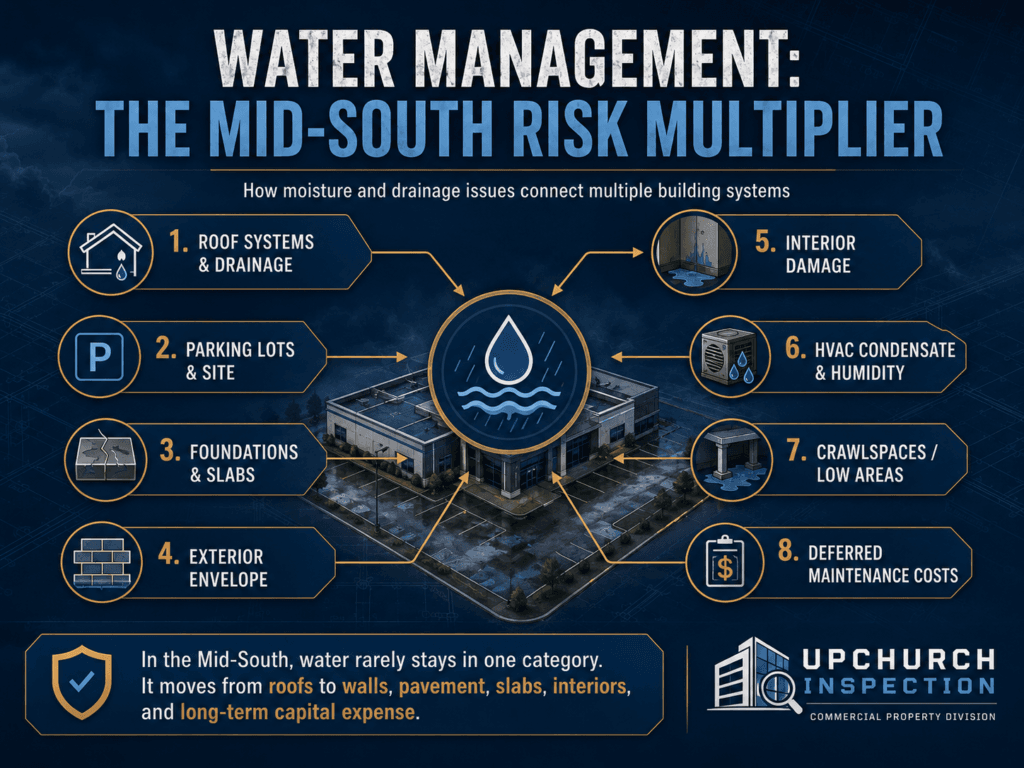
Memphis Storm Water explains the same practical issue inspectors see in the field: as land is developed, roads, sidewalks, parking lots, and rooftops increase the amount of impervious surface. When stormwater hits those surfaces, it is not absorbed; it flows faster and becomes runoff. (Memphis Storm Water)
That matters directly to commercial properties.
Commercial buildings often have large roof areas and large paved areas. They shed a lot of water. That water has to go somewhere. If roof drains are clogged, gutters overflow, downspouts discharge at the foundation, parking lots hold water, storm drains are blocked, or grading directs water toward the building, the result is not just inconvenience. It can become roof deterioration, pavement failure, moisture intrusion, erosion, foundation movement, crawlspace humidity, tenant complaints, or interior damage.
The City of Memphis also makes clear that drainage is a real infrastructure issue, not just a property-owner annoyance. Its Drain Maintenance department reports servicing approximately 56,000 drainage inlets, 1,839 miles of underground drainage infrastructure, and 158 miles of concrete channel-lined ditches. (The City of Memphis)
That public infrastructure context matters because private commercial properties are part of the same water-management environment. A building owner may control the roof, gutters, downspouts, grading, parking lot, and private drains, but those systems interact with broader drainage infrastructure. When a property is poorly graded, paved, or maintained, water problems do not stay neatly in one place.
For commercial due diligence, the practical point is simple:
In the Mid-South, water is not just a roof issue. It is a roof issue, a site issue, a pavement issue, a drainage issue, and sometimes a foundation or slab issue.
That is why this report repeatedly returns to water management.
The roof matters. The gutters matter. The scuppers matter. The downspouts matter. The parking lot matters. The grading matters. The stormwater path matters. The interior staining matters. The crawlspace or slab conditions matter. Commercial buildings may look sturdy, but water is patient. It finds the weak points over time.
Humidity also matters. High humidity and long cooling seasons increase the importance of mechanical systems. Rooftop units, package units, split systems, and interior air-handling components have to manage cooling and moisture loads. When equipment is old, dirty, poorly maintained, improperly draining condensate, or insufficient for current use, the result may not be immediate failure. It may show up as comfort complaints, interior humidity, ceiling staining, biological growth concerns, condensation, or service calls.
That is why Mid-South commercial buildings should be evaluated through a regional lens.
A generic checklist can identify many defects. But regional field experience helps interpret those defects. An inspector working in this area should understand that a short downspout, clogged roof drain, low area in a parking lot, or stained ceiling tile may be part of a broader water-management story. They should understand that rooftop HVAC equipment exposed to heat, humidity, and storms can carry lifecycle risk even if it runs during the inspection. They should understand that older commercial buildings may have been patched and adapted for decades rather than maintained as planned assets.
This does not mean every older commercial property is a bad investment.
It means the buyer needs to understand the conditions that local buildings commonly carry.
Seismic and Soil Considerations in the Mid-South
Commercial due diligence in the Mid-South should also acknowledge a regional risk that outside investors sometimes overlook: seismic exposure.
Memphis, Cape Girardeau, Southeast Missouri, and portions of the broader Mid-South are influenced by the New Madrid Seismic Zone. USGS materials identify the Memphis area as a large urban area prone to damage from earthquakes in the New Madrid Seismic Zone, which extends from southeastern Missouri to northwestern Tennessee and northeastern Arkansas. (USGS Earthquake Hazards)
This does not mean every commercial building is unsafe, and a standard commercial inspection is not a seismic engineering evaluation. However, regional seismic and soil context may affect how visible masonry cracking, foundation movement, parapet conditions, settlement, and older structural systems are interpreted.
Liquefaction is another regional issue that can matter in certain locations. A USGS-supported liquefaction potential mapping report for Memphis and Shelby County states that Holocene alluvial deposits associated with floodplains of major rivers in the area have the greatest potential for liquefaction. (USGS Earthquake Hazards) USGS also provides Memphis urban seismic hazard map data that includes ground motion and liquefaction hazard mapping for the Memphis area. (USGS)
For commercial buyers, the practical point is not to turn every inspection into a seismic study. The point is to recognize when visible conditions justify structural engineering review before closing. Older masonry buildings, churches, warehouses, mixed-use buildings, industrial structures, and properties that have been modified over time may deserve closer review when there is visible cracking, displaced masonry, deteriorated parapets, foundation movement, wall separation, unusual settlement, or significant slab displacement.
A local commercial inspection should not ignore the fact that Mid-South buildings are shaped by water, soil, age, and seismic context. Those conditions do not automatically make a property a bad investment, but they do affect how risk should be evaluated.
Market Conditions and the “Functional Space” Problem
Commercial buyers do not just need space.
They need usable space.
This distinction matters in markets where commercial activity is strong or where buyers are competing for functional buildings. Memphis, in particular, has a strong industrial and logistics identity. CBRE reported that Memphis industrial demand strengthened in 2025, with 4.8 million square feet absorbed in Q4 2025 and another 863,000 square feet absorbed in Q1 2026; CBRE also reported that vacancy declined to 6.0% in Q1 2026.
I would verify the final CBRE source directly before publishing that exact sentence. If you want to avoid relying on market figures, the sentence can be replaced with: “Memphis remains a major logistics and industrial market, which makes the condition and functionality of warehouse, distribution, and light-industrial properties especially important during due diligence.”
The broader point remains true: market demand does not erase physical risk.
A warehouse may be well located and still have slab problems. An office building may be marketable and still have aging HVAC. A church campus may be a strong opportunity and still have multiple roof systems near major repair. A retail building may sit in a good corridor and still have drainage, parking lot, roof, or electrical limitations.
A building can be available without being ready.
A warehouse with enough square footage may still fail the buyer’s practical needs if the slab is uneven, the overhead doors are damaged, the loading area floods, the roof leaks over inventory, or the electrical service cannot support the intended operation. A medical office may be usable for the prior tenant but expensive to adapt for the next user. A daycare may need more than clean finishes; it may need serious attention to life safety, HVAC reliability, plumbing, exterior access, and accessibility-related conditions. A church building may look functional on Sunday but still carry major capital exposure in the roof, parking lot, HVAC systems, kitchens, classrooms, or drainage.
Commercial real estate marketing often focuses on location, square footage, traffic count, tenant potential, ceiling height, dock doors, lease rates, income, and access.
Those things matter.
But after closing, the buyer owns the physical building. The roof, slab, drainage, electrical service, plumbing, parking lot, and deferred maintenance do not care what the brochure said.
That is why commercial due diligence should ask:
Is this space functional for the buyer’s intended use, or only available?
That question belongs in the inspection conversation.
Functional space is not just square footage. It is the combination of roof performance, slab condition, loading access, power, lighting, drainage, fire/life-safety conditions, office build-out quality, and the absence of major deferred maintenance that would prevent the buyer from using the property as intended.
The same idea applies outside industrial buildings.
Retail space has to support customers, tenants, signage, parking, storefronts, HVAC, and interior build-outs. Office space has to support comfort, technology, restrooms, access, lighting, and a professional environment. Medical and daycare properties must be evaluated with public use, life safety, HVAC reliability, plumbing, and accessibility-related concerns in mind. Churches and campuses have to serve people, programs, assemblies, classrooms, kitchens, offices, parking, and long-term stewardship.
The market may value location and space.
The buyer still inherits condition.
Buildings That Have Been Adapted for Decades
Many commercial buildings in the Mid-South are layered buildings.
They were not designed once, built once, maintained perfectly, and left untouched. They were expanded, divided, renovated, re-tenanted, patched, converted, and adapted over decades.
That history matters.
A church campus may have an original sanctuary, a later education wing, a fellowship hall from another era, classrooms modified over time, a kitchen that has been updated in pieces, and multiple HVAC systems installed as budgets allowed. A warehouse may include an office build-out added long after the original shell was built. A retail property may have been converted into a medical office, daycare, restaurant, or assembly space. A multifamily property may have been renovated unit by unit, with newer finishes over older plumbing or electrical systems. A mixed-use building may have commercial spaces below and residential or storage areas above, with unclear boundaries between systems.
Layered buildings often create layered risk.
The roof transitions between old and new additions may be vulnerable. Electrical panels may have been added over time without clear labeling. Plumbing may be a mix of original lines, partial repairs, and newer fixtures. HVAC equipment may vary in age and type across the building. Interior finishes may look updated while the underlying systems remain old. Tenant improvements may have been performed by different contractors, owners, or maintenance crews with inconsistent quality.
A fresh build-out can make a building look improved without making the building less risky.
That is one of the most common mistakes buyers make. They see new flooring, paint, fixtures, lights, or office finishes and assume the building has been upgraded. Sometimes it has. Sometimes only the visible surfaces have been improved.
The inspection has to look beyond appearance.
The real questions are:
What systems were actually updated?
Were roof transitions handled correctly?
Do the HVAC systems match the current use?
Was electrical work professionally completed?
Are plumbing repairs isolated or repeated?
Are records available?
Does the building’s physical condition support the way the buyer intends to use it?
Layered buildings are not automatically bad. Many are valuable, useful, and worth owning. But they require closer attention because their defects often live at the transitions: old to new, one tenant to another, one addition to another, one system to another.
This is especially true when commercial buildings have gone through multiple tenants. A former retail space may have been turned into offices. A former office may have been converted into a daycare. A warehouse may have gained restrooms, mezzanines, offices, equipment pads, ventilation modifications, or electrical runs for a prior tenant. A restaurant may leave behind plumbing, grease-related concerns, floor drains, gas piping, ventilation penetrations, and equipment connections that may or may not serve the next buyer.
Every use leaves evidence.
Sometimes that evidence is obvious: patched walls, abandoned wiring, old roof penetrations, sealed floor drains, removed equipment bases, or stained concrete. Sometimes it is subtle: inconsistent panel labeling, unexplained ceiling repairs, odd plumbing routes, mismatched HVAC zones, or exterior penetrations that do not seem to belong to the current use.
A careful commercial assessment should look for that history.
The buyer is not only buying what the building is today. The buyer is inheriting what the building has been.
Commercial buildings usually do not fail in clean categories.
They fail where decisions accumulated.
Roof Systems and Drainage: The First Major Capital Risk
A commercial roof can be dry on inspection day and still be a major financial risk.
That point cannot be repeated enough.
Commercial buyers often ask whether the roof leaks. That is a fair question, but it is too narrow. A roof may not be actively leaking during the inspection and still show ponding water, deteriorated flashing, open seams, aged membrane, clogged drains, patched areas, soft spots, parapet deterioration, damaged coping, or problems around rooftop equipment.
Commercial roofs are often low-slope or flat systems. Unlike steep residential roofs, they rely heavily on drainage design, membrane condition, seams, flashing, roof edges, drains, scuppers, gutters, and ongoing maintenance. A small defect at a roof penetration or curb can lead to interior damage far away from the actual entry point. A clogged drain can turn a manageable rainfall event into standing water. A roof-mounted HVAC unit can create penetrations, curb flashing issues, condensate discharge, and service-traffic damage.
The roof is one of the first places commercial due diligence should focus because roof replacement can become one of the largest capital expenses on the property.
A seller may say, “It does not leak.” That may be true as far as they know. It may also be incomplete. A roof may leak only during wind-driven rain. It may leak only when drains are clogged. It may have leaked before and been patched. It may be near the end of useful life but not yet failing dramatically. It may have undocumented repairs. It may have a warranty that is expired, non-transferable, or dependent on maintenance that was never performed.
For commercial buyers, the better question is not just:
Is the roof leaking?
The better question is:
How much roof and drainage risk am I buying?
Roof drainage deserves special attention in the Mid-South because heavy rain and large impervious surfaces create real water-management demands. EPA guidance explains that stormwater runoff is generated when rain or snowmelt flows over impervious surfaces such as paved streets, parking lots, and building rooftops rather than soaking into the ground. (University of Memphis) In commercial settings, those rooftops and paved areas can be large.
The inspection should look for conditions such as ponding water, clogged drains, stained ceiling tiles, roof patches, deteriorated sealant, soft or deteriorated roof surfaces, open seams, failing flashing, damage around roof-mounted units, and poor discharge of roof water after it leaves the roof.
Interior clues matter too. Stained ceiling tiles, rusted grid, damaged insulation, musty odors, patched drywall, and recurring finish repairs can all suggest past or present water intrusion. One stain may have an old explanation. Multiple stains across a building under an aged or poorly drained roof tell a more serious story.
Roof documentation matters as well. Buyers should ask for roof age, installation records, warranty information, repair invoices, maintenance logs, leak history, coating records, and any recent roof contractor evaluations. A well-documented roof is not automatically problem-free, but documentation reduces uncertainty. An undocumented roof leaves the buyer guessing.
And in commercial real estate, guessing about the roof is expensive.
When roof concerns appear significant, a commercial roof inspection or commercial roofing contractor evaluation should occur before the due diligence period expires. A general commercial inspection can identify visible risk, but repair pricing, replacement options, moisture scans, core samples, warranty interpretation, and roof certifications require roof-specific expertise.
That is not a weakness in the inspection process.
That is proper due diligence.
A good commercial report should also explain the limitations of roof evaluation. Not every roof can be safely accessed. Weather, height, fragile materials, lack of access, tenant control, or safety conditions may limit the inspection. If the roof is not accessed, that limitation should be stated clearly. A buyer should not interpret “not observed” as “no concern.” It means the risk remains unresolved.
For larger properties, unresolved roof risk is rarely something to ignore.
The buyer may need a roof contractor, drone review, maintenance records, warranty documents, infrared scan, core sample, or pricing proposal depending on the size, age, and visible conditions.
Commercial roofs are not just coverings.
They are financial obligations overhead.
Rooftop HVAC and Mechanical Lifecycle Risk
Working today does not mean low risk.
That is the most important thing to understand about commercial HVAC systems.
Many commercial buildings in the Mid-South rely on rooftop units, package units, split systems, boilers, chillers, or other mechanical equipment. During a showing, the building may feel comfortable. Air may be moving. The thermostat may respond. The seller may say the units work.
That does not tell the whole story.
A rooftop unit can operate during the inspection and still be near the end of its practical life. It can cool a space on a mild day while struggling under peak summer load. It can heat or cool while showing rust, dirty coils, damaged line insulation, poor condensate management, electrical wear, poor service access, or repeated repairs. It can be “working” and still represent a capital expense.
The risk grows when a building has multiple units.
One old unit is a repair concern. Six old units are a replacement-cycle concern. A church campus, retail building, office complex, medical building, or school may have numerous systems serving different zones. If those systems were installed around the same time, the buyer may face clustered replacement costs. If records are missing, the buyer may not know what has been serviced, replaced, or neglected.
ASHRAE’s service-life and maintenance-cost database exists to provide information on the service life and maintenance costs of typical HVAC equipment, reinforcing the fact that HVAC equipment lifecycle and operating cost are legitimate planning considerations for building owners and facility managers. (weblegacy.ashrae.org)
In the Mid-South, long cooling seasons and humidity make mechanical systems especially important. HVAC problems are not just comfort problems. They can affect tenant satisfaction, indoor humidity, employee productivity, patient comfort, childcare operations, church services, events, retail customers, and business continuity. In some properties, HVAC reliability is central to the use of the space.
Visible HVAC concerns may include cabinet corrosion, damaged insulation, dirty coils, poor condensate drainage, disconnected or damaged ductwork, unsafe electrical disconnects, missing service panels, gas piping concerns, poor clearance, inaccessible equipment, or signs of repeated repair.
Condensate management deserves its own attention. Cooling equipment in humid climates creates water. If that water is poorly drained, discharged onto roof surfaces, leaking into building areas, or causing staining around units, the HVAC system becomes part of the moisture-risk picture.
Service records are critical. A building with older but well-maintained units and clear documentation may represent a different risk than a building with unknown system ages, no maintenance records, visible deterioration, and tenant comfort complaints.
The buyer should ask:
Which unit serves which area?
How old are the units?
Are service records available?
Which units have been replaced?
Are tenants reporting comfort problems?
Are systems sized and configured for the current or intended use?
Are there signs of deferred maintenance?
Are there roof leaks or patches near the units?
A commercial inspection should not pretend to be a full mechanical contractor evaluation. Refrigerant charge, heat exchanger condition, internal component testing, design capacity, and detailed performance diagnostics require HVAC-specific expertise. But the inspection can identify age-related risk, visible deterioration, lack of documentation, operational concerns, and situations where HVAC contractor review should occur before closing.
HVAC also connects to roof risk. Rooftop units create roof penetrations, require service access, and often concentrate roof wear around curbs, lines, and condensate discharge. A mechanical issue can become a roofing issue, and a roofing issue can affect the mechanical equipment.
That is why commercial systems should not be evaluated in isolation.
The buyer should not ask only:
Does the HVAC work?
The better question is:
What mechanical risk am I inheriting, and how could that affect ownership costs?
Parking Lots, Site Drainage, and Exterior Water Management
The site is part of the asset.
Commercial buyers sometimes focus on the building and treat the parking lot, sidewalks, drainage, curbs, loading areas, exterior stairs, ramps, and grading as secondary. That is a mistake.
Site conditions can create real cost and real liability.
A deteriorated parking lot may still hold cars, but it may be approaching major repair. Cracked asphalt, alligator cracking, failed patching, settlement, potholes, damaged curbs, ponding water, poor striping, uneven sidewalks, and trip hazards can all affect operation and safety. For churches, medical offices, retail spaces, daycares, multifamily properties, and office buildings, the parking lot is part of the public-facing experience. For warehouses and industrial buildings, pavement and drainage may affect truck movement, loading areas, and daily operations.
Drainage is the thread that connects many site issues.
EPA identifies streets, parking lots, buildings, and other surfaces where water does not soak into the ground as impervious surfaces that generate stormwater runoff. (University of Memphis) Memphis Storm Water makes the same practical point locally: roofs, sidewalks, streets, and parking lots increase hard surfaces that do not absorb stormwater. (Memphis Storm Water)
When water cannot soak in, it moves.
If the site is designed and maintained well, water moves away from the building and toward appropriate drainage paths. If not, it collects in parking areas, runs toward foundations, enters loading zones, erodes soil, contributes to pavement failure, overwhelms drains, saturates crawlspaces, or affects exterior walls.
That is why commercial drainage should be inspected as a system.
Roof water, gutter discharge, downspouts, grading, pavement slope, storm drains, swales, retaining walls, curbs, catch basins, and discharge points all matter. If water leaves the roof and lands at the building foundation, the roof drainage problem has become a site problem. If a parking lot holds water near the entrance, that is not just a pavement issue. It may be a safety, access, drainage, and maintenance issue.
The inspection should identify visible site conditions that may affect building performance or ownership cost. It should not claim to perform civil engineering, stormwater design, or underground drainage evaluation unless those services are specifically included. But it should not ignore obvious water-management concerns either.
Commercial property owners often underestimate parking lots because pavement deterioration can look gradual. A crack becomes a larger crack. A patch fails. A low area holds water. Water enters the base layer. Settlement increases. The lot remains usable until the cost of repair becomes much larger than early maintenance would have been.
The same is true of sidewalks and exterior walking surfaces. Uneven concrete, settlement, ponding water, broken curbs, damaged ramps, and trip hazards can affect safety and access. For properties used by the public, children, elderly members, patients, tenants, customers, or employees, exterior conditions are not just cosmetic.
Loading areas require even more attention. Industrial and warehouse sites often depend on functional drive lanes, dock aprons, overhead doors, and truck courts. Poor drainage at a loading dock can affect operations. Damaged concrete can affect truck movement. Ponding water near overhead doors can enter the building. Pavement failure can slow daily use.
A commercial building does not stop at the exterior wall.
The site is part of the risk profile.
Water tells you how a property is aging.
Commercial buyers should listen.
Plumbing Patterns and Water Damage
One leak is a repair.
Repeated leaks are a pattern.
That distinction matters in commercial buildings, especially multifamily, churches, schools, restaurants, medical offices, retail centers, and older mixed-use properties.
Plumbing defects are not always dramatic during a walkthrough. A sink may drain. A toilet may flush. Water may run. But the signs of long-term plumbing risk often show up around the system: stained cabinet bases, patched ceilings, loose toilets, soft floors, old water heaters, corroded piping, slow drains, active leaks, mismatched repairs, moisture stains, and repeated damage below wet areas.
In multifamily properties, plumbing patterns are especially important. A leaking sink in one unit may be routine. Similar leaks, stains, soft bathroom floors, patched drain lines, and recurring ceiling damage across multiple units may suggest systemic maintenance issues. In churches and schools, restrooms and kitchens may see irregular but intense use. A building may seem fine during the week but experience problems during services, events, or school operations. Restaurants and food-service spaces add their own concerns, including grease, floor drains, commercial sinks, heavy fixture use, and drainage demands.
Water damage multiplies cost.
A leak is rarely just a leak. It can damage cabinets, flooring, walls, ceilings, framing, insulation, electrical components, tenant finishes, stored materials, and indoor air quality. In occupied commercial properties, repairs can also create disruption. A plumbing problem in one area may shut down a restroom, kitchen, tenant space, classroom, or unit.
The inspection should help the buyer understand whether plumbing concerns appear isolated, repeated, active, historical, or significant enough to justify further evaluation. Sewer scoping may be appropriate when drainage concerns, older sewer lines, heavy use, root intrusion, backups, or unknown underground conditions are present.
A commercial inspection does not see behind walls or under slabs. It does not guarantee hidden piping condition. But visible plumbing patterns can still provide valuable information.
Water heaters deserve special attention in commercial properties because they are easy to ignore until they fail. An older water heater with corrosion, poor installation conditions, missing safety components, leakage evidence, or inadequate capacity can affect restrooms, kitchens, tenant spaces, or operations. In institutional properties, a water heater failure may disrupt more than convenience. It may affect childcare, food preparation, cleaning, or events.
Plumbing also interacts with roof and drainage concerns. A stained ceiling tile may come from a roof leak, an HVAC condensate issue, a plumbing leak above, or a prior condition that was repaired. The inspection should not assume the cause without evidence. But it should identify the stain and recommend further evaluation when the source is unclear.
When the same type of water-related defect appears repeatedly, the building is telling you something.
The buyer should not ignore it.
Electrical Service, Future Use, and Power Demand
A building may have power, but not necessarily the right power.
That is a critical commercial due diligence issue.
Electrical service is not just a safety topic. It is also a future-use topic. A building that was adequate for one tenant may not be adequate for another. A warehouse used for storage may have different needs than one used for light manufacturing. A retail space converted into a restaurant may require significant electrical changes. A medical office may have equipment demands. A daycare, school, church, or office may need updated circuits, lighting, HVAC support, life-safety systems, or technology infrastructure.
The inspection should evaluate visible electrical conditions, but the buyer must also consider intended use.
Common concerns include aging panels, poor labeling, open junction boxes, exposed wiring, abandoned wiring, missing covers, damaged disconnects, improper tenant modifications, overloaded-looking conditions, poor access to equipment, damaged exterior electrical components, and questionable wiring near rooftop units, kitchens, mechanical rooms, or build-outs.
A general commercial inspection is not a load calculation, engineering study, or design review. It cannot guarantee that the electrical system supports the buyer’s intended use. But it can identify visible concerns and recommend electrical contractor or engineer review where capacity, condition, or future use may be material to the deal.
The question is not just:
Do the lights turn on?
The better question is:
Does this electrical system safely and practically support what the buyer plans to do here?
That question should be answered before closing, not after the buyer discovers an expensive upgrade requirement.
Electrical issues also reveal maintenance culture. A clean, well-labeled, accessible electrical system tells one story. Panels blocked by storage, missing covers, open boxes, abandoned wiring, unlabeled circuits, and tenant modifications tell another.
In some commercial buildings, electrical work has been modified for decades. A tenant adds equipment. A previous owner adds lighting. Another tenant removes a wall. A new panel is added. An old circuit is abandoned. A rooftop unit is replaced. A kitchen is expanded. A storage room becomes an office.
Over time, the system can become difficult to understand.
That uncertainty matters.
When the buyer’s intended use depends on electrical reliability or capacity, further review should occur before closing.
Slabs, Foundations, and Structural Movement
In some commercial buildings, the slab is not just a floor.
It is part of the operation.
This is especially true in warehouses, industrial buildings, distribution spaces, service facilities, storage properties, and buildings with equipment, vehicles, forklifts, pallet jacks, racking, or heavy inventory. A slab that is cracked, displaced, settled, spalling, uneven, moisture-affected, or poorly repaired can affect more than appearance. It can affect how the building functions.
Not every crack is a structural failure. Concrete cracks. Masonry cracks. Buildings move. Some cracks are shrinkage-related or cosmetic. Others suggest settlement, moisture movement, soil conditions, loading issues, structural movement, impact damage, or prior repair failure.
The inspection should look for context.
Is the crack displaced? Does it create a trip or forklift hazard? Does it align with wall cracking, door movement, water intrusion, exterior settlement, or drainage problems? Does it affect racking layout? Does it cross loading areas? Does it interfere with overhead doors? Does it suggest slab movement near docks or operational zones?
For industrial properties, loading docks and overhead doors deserve attention. Damaged concrete, poor drainage, misaligned doors, deteriorated dock edges, failed bumpers, rusted frames, and impact damage may affect daily operations. A warehouse that cannot efficiently receive or ship goods may be physically standing but operationally compromised.
Regional water and soil context also matters. Poor grading, ponding water, erosion, and concentrated roof discharge can affect slabs, foundations, masonry, and pavement over time.
A general inspection can document visible conditions and recommend further evaluation. It does not replace structural engineering. If cracking, settlement, displacement, deflection, movement, or structural distress appears significant, a structural engineer should evaluate the condition before the buyer accepts the risk.
The slab may be below the buyer’s feet, but in industrial real estate it can sit at the center of the deal.
Foundation concerns can also show up in older commercial buildings, churches, multifamily properties, and mixed-use structures. Cracked masonry, sloped floors, sticking doors, displaced walls, stair-step cracking, separated trim, or water entry near foundation areas may all deserve closer attention. Some conditions may be old and stable. Others may be active or related to drainage.
The inspection should not overstate structural conclusions. It should document visible evidence and recommend engineering review when conditions go beyond the scope of a visual assessment.
In commercial due diligence, the goal is not to guess.
The goal is to know when guessing is not good enough.
Exterior Envelope and Building Skin
Commercial buildings usually do not fail at one point.
They fail at edges, joints, transitions, penetrations, and neglected exterior details.
The exterior envelope includes the building’s skin: walls, masonry, siding, panels, windows, doors, sealants, parapets, flashing, trim, soffits, fascia where present, penetrations, louvers, vents, and transitions between materials. These components protect the building from water, air, pests, and weather exposure.
Deferred maintenance often shows up here before it shows up inside.
Sealants crack. Masonry joints deteriorate. Exterior panels loosen. Paint fails. Wood trim rots. Windows leak. Doors rust. Wall penetrations are poorly sealed. Parapets crack. Coping gaps open. Flashing details fail. Small openings become water paths.
Commercial buyers may focus on roofs and HVAC because those are obvious capital items. But exterior envelope problems can be just as important because they allow water into the building gradually. A small sealant failure repeated across dozens of windows can become a building-wide maintenance issue. A deteriorated masonry wall can create water intrusion, structural concerns, or expensive repointing. Poorly sealed penetrations can allow moisture, pests, or air leakage. Exterior wall staining may reveal roof drainage problems above.
The building skin also reveals maintenance culture.
A building with clean joints, maintained sealants, controlled drainage, repaired wall openings, and organized exterior maintenance tells one story. A building with failing caulk, open penetrations, deteriorated trim, stained walls, patched masonry, and water damage tells another.
Exterior envelope concerns should not be dismissed as cosmetic until the risk is understood. In commercial due diligence, “just maintenance” can still mean real money.
Exterior doors and windows deserve attention for the same reason. They are openings in the building envelope. Poor weatherstripping, rusted frames, damaged thresholds, cracked glass, poor drainage at sills, and failed sealants can all contribute to water intrusion or energy loss. In retail and office properties, exterior appearance can also affect tenant and customer perception. In churches and institutional properties, older windows and doors may be part of a larger maintenance backlog.
Parapets are a common commercial risk area. They are easy to overlook from the ground, but they may combine roof, wall, flashing, and masonry concerns in one location. Deteriorated coping, cracked masonry, failed sealant, poor flashing, or open joints can allow water into wall assemblies. A parapet problem may not show up as an immediate leak. It may appear later as interior staining, masonry deterioration, or hidden moisture.
The exterior envelope is where the building fights weather every day.
If that fight has been neglected, the inspection will usually show it.
Life Safety and Accessibility-Related Observations
Visible safety concerns matter.
But scope matters too.
A commercial inspection is not automatically a full building code inspection, fire marshal inspection, ADA compliance audit, architectural review, or life-safety engineering study. Those are separate evaluations and may require specific professionals or local authorities.
That said, a commercial inspection should not ignore obvious visible concerns simply because it is not a code inspection.
Stairs, handrails, guards, walking surfaces, emergency lighting, exit signage, electrical hazards, damaged doors, blocked exits, smoke alarms, carbon monoxide alarms where applicable, fire separation observations, and obvious hazards in public or occupied areas can all matter. In churches, schools, daycare facilities, medical offices, multifamily properties, retail spaces, and assembly buildings, these issues can be especially important because the public, children, patients, congregation members, employees, tenants, or visitors may use the property.
Accessibility-related observations should also be handled carefully. A general commercial inspection should not claim to certify ADA compliance unless that service is specifically scoped and performed by qualified professionals. However, visible concerns involving parking, routes, ramps, entrances, doorways, restrooms, stairs, level changes, and public access can still affect risk, renovation planning, and future use.
The right approach is clear and honest:
The report should not overstate the scope, but it should not ignore obvious visible concerns either.
When safety or accessibility-related concerns are observed, the report should document the condition and recommend further evaluation by the appropriate contractor, design professional, accessibility consultant, fire protection professional, or local authority where needed.
Commercial buyers should understand that longtime use of a building does not automatically mean the building is appropriate for future use. Occupancy changes, tenant changes, operational changes, public use, renovations, and lender or insurance requirements can all change the practical risk.
This is especially important in properties where people gather or where vulnerable populations use the space. Churches, schools, daycares, medical offices, community centers, and multifamily buildings carry a different level of public and organizational responsibility than a low-occupancy storage building.
A loose handrail in an unused storage area may be a repair item. A loose handrail on a main stair serving a school wing, church entrance, apartment building, or medical office is a different kind of concern. A missing cover plate in a locked mechanical room is a defect. Open electrical components in a public or child-accessible space carry a different significance.
A good report should help the client understand that difference.
The goal is not to turn every commercial inspection into a code enforcement action. The goal is to document visible risk and recommend the right next step.
Deferred Maintenance: The Pattern Behind the Defects
Deferred maintenance is often the real story.
The most expensive commercial properties are not always the ones with one dramatic defect. They are often the ones where every system has been pushed just far enough to become the next owner’s problem.
Deferred maintenance rarely shows up as one clean category. It appears as a pattern.
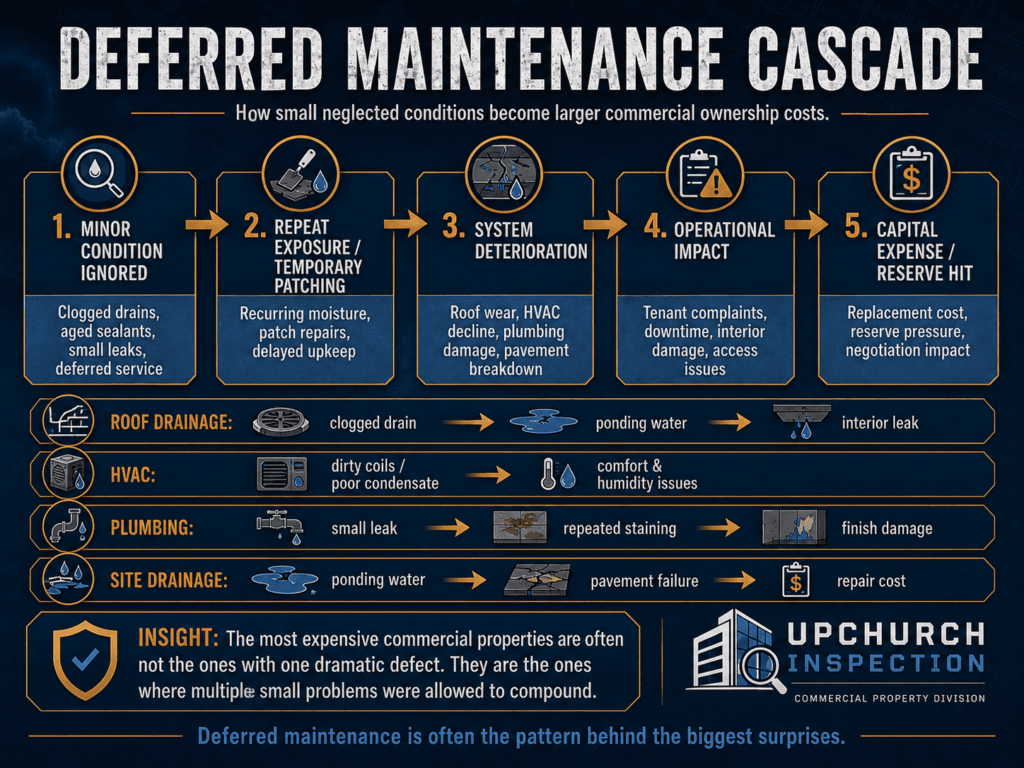
Roof patches. Dirty HVAC coils. Rusted rooftop units. Missing service records. Cracked pavement. Poor drainage. Old plumbing stains. Loose toilets. Deteriorated sealants. Missing electrical covers. Open junction boxes. Stained ceiling tiles. Damaged doors. Failed exterior paint. Unmaintained gutters. Blocked drains. Soft floors. Worn stairs. Old water heaters. Poorly labeled panels. Abandoned wiring. Temporary repairs that became permanent.
Each item may be manageable by itself.
Together, they describe ownership history.
A building that has been maintained proactively usually shows it. Records exist. Systems are labeled. Repairs are consistent. Roof drainage is kept clear. HVAC units are serviced. Plumbing leaks are addressed properly. Exterior openings are sealed. Parking lots are maintained. Problems are not allowed to compound.
A building maintained reactively also shows it. Repairs are inconsistent. Records are missing. Systems are patched. The roof has multiple undocumented repairs. HVAC units are dirty and corroded. Plumbing stains remain. Electrical work appears improvised. Water is not controlled. The parking lot is deteriorated. The building functions, but only because problems have been tolerated.
For a commercial buyer, deferred maintenance matters because it changes the economics of ownership.
It affects capital reserves. It affects repair priorities. It affects lender confidence. It affects tenant satisfaction. It affects negotiation. It affects whether the property is truly priced correctly. It affects whether the buyer will spend the first years of ownership operating the property or catching up on someone else’s neglect.
A good commercial report should identify deferred maintenance patterns. It should not treat every item as isolated if the property is clearly telling a larger story.
The pattern is often more important than the defect.
Deferred maintenance is also one of the reasons cosmetic renovation can be misleading. A seller may improve paint, flooring, fixtures, and lighting before sale. Those improvements may make the property more marketable, but they do not necessarily address roof age, mechanical lifecycle, drainage, electrical limitations, hidden plumbing history, parking lot deterioration, or exterior envelope failure.
This is common in income-producing properties.
The areas that photograph well get attention. The systems that cost the most may remain untouched.
That does not mean cosmetic improvements are bad. They may increase rentability and usability. But commercial buyers should not confuse appearance with condition.
The inspection should ask:
What has actually been maintained?
What has been patched?
What has been ignored?
What documentation exists?
Which systems are being pushed to the next owner?
Which costs are hiding behind finishes?
Deferred maintenance is the building’s history showing up in the inspection.
How Risk Changes by Property Type
Commercial risk is not the same across all property types.
A warehouse, church, multifamily building, retail center, medical office, daycare, and mixed-use building all have roofs, electrical systems, plumbing, HVAC, site conditions, and maintenance concerns. But the importance of each system changes depending on how the property is used.
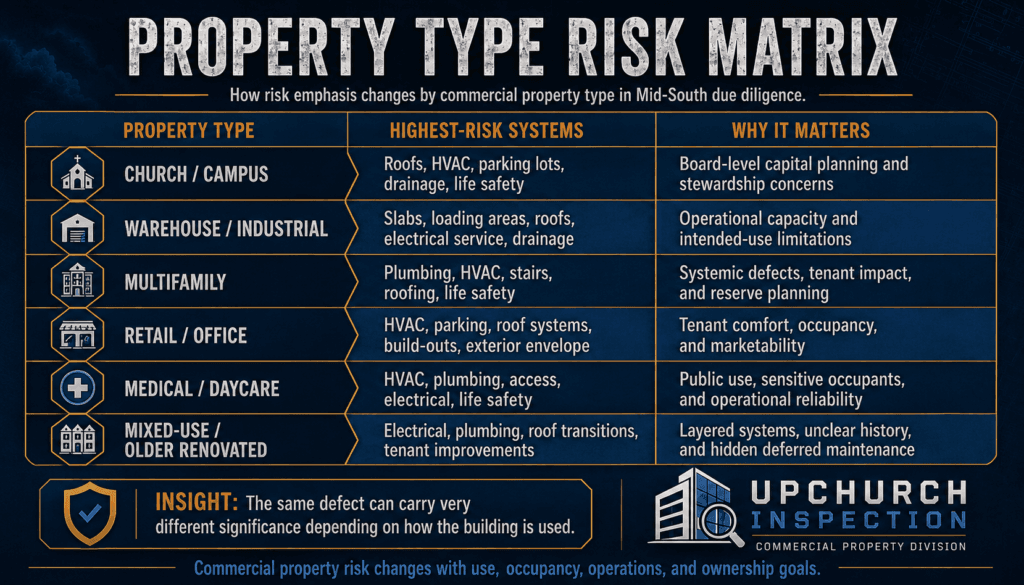
Churches and Campuses
Church and campus property inspections often involve board-level risk, long-term stewardship concerns, and multiple building systems from different eras.
They may include sanctuaries, classrooms, kitchens, fellowship halls, offices, daycare wings, gymnasiums, storage areas, parking lots, and multiple buildings from different eras. They often have large roofs, multiple HVAC systems, significant public access, older additions, and deferred maintenance caused by budget constraints.
For trustees and boards, the inspection is not just about defects. It is about stewardship. The report may need to help responsible people decide whether to buy, renovate, fundraise, borrow, repair, or phase improvements.
Churches and nonprofit campuses often have a unique maintenance profile. The building may be loved, heavily used, and underfunded at the same time. Volunteers may handle some repairs. Major systems may be postponed because the money is needed elsewhere. A roof repair may wait. An HVAC unit may get one more service call. A parking lot may be patched instead of resurfaced. A classroom wing may be used for years despite aging finishes, old electrical conditions, or moisture stains.
That creates a specific kind of due diligence problem.
The property may be mission-critical, but the maintenance history may be uneven.
A board does not need vague reassurance. It needs a clear description of visible conditions, likely priorities, limitations, and specialist follow-up. It needs to know whether the roof should be evaluated before closing. It needs to know whether multiple HVAC units appear aged. It needs to understand drainage around the campus. It needs to know whether classrooms, kitchens, assembly spaces, and walking surfaces show safety-related concerns. It needs to know whether the property carries immediate repair risk or longer-term capital planning concerns.
A church building is not just a building.
It is a responsibility.
Warehouse and Industrial
Warehouse and industrial building inspections should focus on operational capacity, not just whether the structure is standing.
The slab matters. Roof leaks matter. Loading docks matter. Overhead doors matter. Electrical service matters. Drainage matters. Prior tenant use matters. A warehouse is not just square footage. It has to work for the buyer’s intended use.
A buyer planning light manufacturing, storage, distribution, service operations, or equipment use should understand whether the building physically supports that plan.
Warehouse due diligence should focus on the parts of the building that affect use. Is the slab suitable for forklifts, racking, equipment, or inventory? Are there displaced cracks or settlement? Are loading areas functional? Do overhead doors operate properly? Are there water stains below roof areas where inventory may be stored? Does the roof drainage work? Is site drainage affecting truck access? Is lighting adequate? Is electrical service appropriate for the intended use?
Prior tenant history also matters in industrial properties. Floor stains, abandoned equipment pads, old penetrations, modified electrical systems, floor drains, ventilation changes, and unknown storage history may raise questions. A general inspection is not an environmental site assessment, but it can identify visible conditions that should prompt environmental or specialist review.
In industrial real estate, the building is not just shelter.
It is infrastructure for operations.
Multifamily
Multifamily property inspections should look for systemic risk, not just isolated unit-level defects.
One leak may be a repair. Repeated leaks across several units may be a pattern. One old HVAC system may be manageable. Dozens of aging systems may affect reserves. Unit sampling limitations, life-safety concerns, stairs, walkways, balconies, tenant impact, plumbing patterns, and deferred maintenance all matter.
Multifamily buyers need to know whether defects are isolated or repeated across the asset.
This is where inspection sampling becomes important. In some multifamily inspections, not every unit may be accessible. That limitation should be clear. But even a sample can reveal patterns. If several inspected units show similar plumbing leaks, electrical concerns, HVAC age, moisture staining, soft flooring, or damaged exterior elements, the buyer should consider whether similar conditions may exist elsewhere.
Multifamily properties also place a premium on tenant impact. A plumbing failure is not just a repair. It may affect tenants above and below. A roof leak may affect multiple units. Exterior stair or walkway concerns may create safety issues. Inconsistent smoke alarms or electrical defects may require broader correction. A parking lot drainage issue may affect daily tenant use.
The investor’s spreadsheet may assume ordinary maintenance.
The inspection may reveal that the building is carrying a backlog.
Retail and Office
Retail and office buildings depend heavily on tenant comfort, access, appearance, parking, HVAC reliability, roof performance, interior build-out quality, and electrical adaptability. A roof leak may affect tenant operations. Poor HVAC may affect renewals. A failing parking lot may affect customer experience. Interior build-outs may hide old systems behind new finishes.
For these properties, the inspection should help the buyer understand whether the building can compete for and support tenants.
For retail, site conditions are often central. Parking, sidewalks, lighting, drainage, storefront condition, signage areas, exterior envelope, and HVAC all affect usability and tenant perception. A building may be in a strong corridor and still require significant investment before it performs well.
Medical and Daycare
Medical offices and daycare buildings require extra care in how they are evaluated and discussed.
HVAC reliability, plumbing, electrical systems, safe walking surfaces, public access, restrooms, life-safety observations, accessibility-related conditions, and interior finishes can all carry more significance because of the users involved. A general inspection should not be misrepresented as a code, licensing, ADA, or healthcare compliance review. But visible concerns should be documented, and further review should be recommended where appropriate.
For daycare properties, children change the risk profile. Electrical hazards, trip hazards, fencing, exits, restrooms, HVAC performance, water intrusion, indoor air quality concerns, and exterior play or access areas may deserve closer attention. For medical offices, HVAC reliability, electrical service, plumbing, accessibility-related conditions, and interior condition may affect operations and patient experience.
The inspection cannot certify a use unless that is part of a separate professional scope. But it can identify visible building conditions that may matter to the buyer’s intended use.
Mixed-Use and Older Renovated Buildings
Mixed-use and older renovated buildings often contain layered systems and unclear boundaries.
Commercial uses may overlap with residential areas, storage spaces, older utility layouts, tenant improvements, and undocumented renovations. These buildings may have mismatched plumbing, electrical modifications, older roof sections, changed occupancy, and confusing maintenance responsibility.
The inspection should pay close attention to how systems interact and where renovations may have hidden older risks.
A mixed-use property may have a retail space below and apartment above. A former residence may have been converted to office use. An old warehouse may now include studios, offices, storage, and assembly areas. The problem is not necessarily the mixed use itself. The problem is when the building’s systems were never fully adapted to match the new use.
Old buildings can be good assets.
But they require honest evaluation.
Property Type Risk Matrix
| Property Type | Highest-Risk Systems | Why It Matters |
|---|---|---|
| Church / Campus | Roofs, HVAC, parking lots, drainage, life safety | Board-level capital planning and stewardship concerns |
| Warehouse / Industrial | Slabs, loading areas, roofs, electrical service, drainage | Operational capacity and intended-use limitations |
| Multifamily | Plumbing, HVAC, stairs, roofing, life safety | Systemic defects, tenant impact, and reserve planning |
| Retail / Office | HVAC, parking, roof systems, build-outs, exterior envelope | Tenant comfort, occupancy, and marketability |
| Medical / Daycare | HVAC, plumbing, access, electrical, life safety | Public use, sensitive occupants, and operational reliability |
| Mixed-Use / Older Renovated Buildings | Electrical, plumbing, roof transitions, tenant improvements | Layered systems, unclear history, and hidden deferred maintenance |
This matrix is not a substitute for a site-specific inspection. It is a quick reference showing how risk emphasis changes by property type. The same defect may carry different significance depending on the building’s use, occupancy, age, and intended function.
Capital Expense and Reserve Planning
Commercial inspections should help clients move beyond “what is wrong today” and toward “what major costs may be waiting after closing.”
That is where capital reserve planning comes in.
Not every commercial inspection includes formal cost opinions. Not every client needs a full reserve study. But every serious commercial buyer should think about future expense exposure.
A roof near the end of service life is not just a roof observation. It is a future capital expense. Multiple aging RTUs are not just mechanical notes. They may represent a phased replacement cycle. A parking lot with cracking, settlement, and ponding water is not just site maintenance. It may become resurfacing, drainage correction, or liability exposure. Repeated plumbing issues may mean more than scattered repairs. Electrical limitations may affect the buyer’s future use.
A simple risk table can help decision-makers understand where to focus:
| Risk Category | Common Observation | Why It Matters | Suggested Follow-Up |
|---|---|---|---|
| Roof | Ponding water, patching, aged membrane | Possible near-term repair or replacement cost | Commercial roofing contractor |
| HVAC | Multiple older RTUs | Clustered replacement cycle | HVAC contractor and service record review |
| Site | Parking lot deterioration and poor drainage | Repair cost, safety, water management | Paving or drainage contractor |
| Plumbing | Repeated stains or active leaks | Possible systemic maintenance issue | Plumbing contractor |
| Electrical | Older panels, poor labeling, tenant modifications | Safety and future-use uncertainty | Electrical contractor or engineer |
| Slab/Structure | Displaced cracking, settlement, movement | Operational or structural concern | Structural engineer |
| Exterior Envelope | Failed sealants, wall staining, deteriorated masonry | Water intrusion and deferred maintenance | Qualified contractor or specialist |
This kind of table does not replace contractor pricing. It helps the buyer know where contractor pricing may be needed.
Capital planning is especially important for investors, lenders, trustees, boards, and property managers. The inspection findings may affect negotiation, reserves, lender discussions, repair credits, post-closing budgets, or whether the purchase price still makes sense.
A commercial building may be a good purchase even with defects.
But the buyer should know what they are accepting.
Capital risk should also be organized by timing. Some issues require immediate attention because they involve active leakage, safety hazards, electrical concerns, or major operational interruption. Some issues are short-term capital concerns, meaning they may not need correction tomorrow but should be expected within the next few years. Some are long-term reserve concerns that should be planned for over the ownership period.
That timing matters.
A buyer may accept an old roof if the price reflects roof replacement. A church board may buy a campus with aging HVAC if it can plan phased replacement. An investor may accept a deteriorated parking lot if the repair cost is included in the financial model. A warehouse buyer may proceed with slab concerns if an engineer confirms the condition is manageable for the intended use.
The problem is not always the defect.
The problem is the surprise.
Good commercial due diligence turns surprises into decisions.
Due Diligence Escalation Table
| Property Condition or Transaction Type | Suggested Next Step |
|---|---|
| Small, simple commercial property with limited systems | General commercial inspection |
| Larger building with multiple major systems | Commercial due diligence inspection |
| Lender, investor, trustee, or board-level transaction | Property Condition Assessment / PCA |
| Significant roof, HVAC, structural, drainage, or electrical concerns | Specialist-coordinated assessment |
| Prior industrial use or visible environmental concern | Environmental professional / Phase I ESA |
| Significant cracking, settlement, masonry movement, or slab displacement | Structural engineer |
| Aged, patched, ponding, or undocumented roof system | Commercial roofing contractor |
| Multiple aging rooftop HVAC units | HVAC contractor and service record review |
| Repeated plumbing leaks or sewer concerns | Plumbing contractor / sewer scope |
| Electrical capacity concerns or intended change of use | Electrical contractor or engineer |
The inspection scope should match the property and the decision being made. A small commercial building may not require the same level of due diligence as a warehouse, church campus, multifamily property, or lender-involved acquisition. The goal is not to over-scope every property. The goal is to avoid under-scoping the ones where physical risk could materially affect the deal.
Common Documentation to Request During Commercial Due Diligence
Physical inspection is only one part of commercial due diligence. Documentation can change the way risk is understood.
When available, buyers should request and review:
- roof warranties
- roof repair invoices
- roof installation records
- HVAC service records
- HVAC equipment replacement dates
- utility bills
- plumbing repair history
- sewer or drain service records
- electrical upgrade records
- permits where available
- prior inspection reports
- environmental reports
- fire system inspection records
- elevator records, if applicable
- maintenance contracts
- tenant complaints related to building systems
- insurance claims involving water, roof, fire, storm, or structural issues
- capital improvement history
- contractor proposals or estimates
- records of major renovations or tenant build-outs
Missing documentation does not automatically prove poor maintenance. But it does increase uncertainty.
A seller with organized roof, HVAC, plumbing, electrical, and maintenance records tells one story. A property with no clear records, no service history, and no explanation for past repairs tells another.
In commercial real estate, uncertainty often becomes risk. Buyers should treat documentation gaps as part of the due diligence picture, especially when visible conditions already suggest deferred maintenance.
What a Commercial Report Should Give the Client
A commercial inspection report should be a decision document, not a defect pile.
That matters because commercial reports are often read by people who were not present at the inspection: buyers, lenders, investors, trustees, board members, attorneys, brokers, facility managers, property managers, contractors, or insurance representatives.
Those readers need context.
The report should explain what was observed, why it matters, what limitations existed, what specialist follow-up may be needed, and how the condition may affect risk. Photos should not just prove that a defect exists. They should support an explanation. Summaries should not replace detail, but they should help decision-makers understand major concerns quickly.
A strong commercial report should include major system summaries, clear narrative findings, photos with context, limitations stated plainly, deferred maintenance patterns, safety-related observations within scope, specialist recommendations where needed, capital-risk language where appropriate, and clear next steps before the due diligence period expires.
The report should also be honest about scope. A general commercial inspection is not the same as a full ASTM-style PCA, environmental assessment, roof certification, structural engineering study, fire inspection, ADA compliance audit, or contractor bid unless those services are specifically included.
That honesty protects the client.
False confidence is dangerous in commercial real estate.
A useful report helps the client understand what is known, what is unknown, what should be evaluated further, and what may affect the decision. If the roof was not accessed, that matters. If tenant spaces were inaccessible, that matters. If maintenance records were not provided, that matters. If specialist evaluation is recommended, the report should explain why.
The report should not be written only for the person walking the property with the inspector. It should be written for the people who may have to approve funding, renegotiate terms, authorize repairs, underwrite the loan, or manage the asset after closing.
That is why narrative reporting has value.
A checklist may identify a condition. A narrative explains the story. Commercial buildings often require that story because systems overlap. Roof drainage affects exterior walls. HVAC condensate affects roofs and interiors. Site drainage affects slabs and parking lots. Plumbing leaks affect tenant spaces. Electrical limitations affect future use. Deferred maintenance affects everything.
A good report helps the client connect those dots.
When a PCA or Specialist-Coordinated Assessment Makes Sense
Some properties need more than a basic commercial walkthrough.
The scope should match the property, the client’s risk tolerance, the transaction, and the decision being made.
A smaller commercial property may only need a general commercial inspection focused on visible condition. A larger or more complex acquisition may need a commercial due diligence inspection with deeper documentation of major systems, deferred maintenance, limitations, and specialist recommendations. A lender-involved transaction, institutional purchase, multifamily asset, large commercial property, or board-level decision may justify a more formal Property Condition Assessment.
ASTM E2018-24 is designed as a baseline process for PCAs, but it also recognizes that use of the standard is voluntary and that the baseline process includes uncertainty. (ASTM International | ASTM) That is important because it reinforces a practical truth: the appropriate level of assessment depends on the client’s objective.
For some properties, the right scope may include coordination with specialists: commercial roofing contractors, HVAC contractors, plumbers, electricians, structural engineers, sewer camera providers, fire protection contractors, elevator contractors, environmental consultants, accessibility consultants, civil or drainage professionals, or other specialists depending on the property.
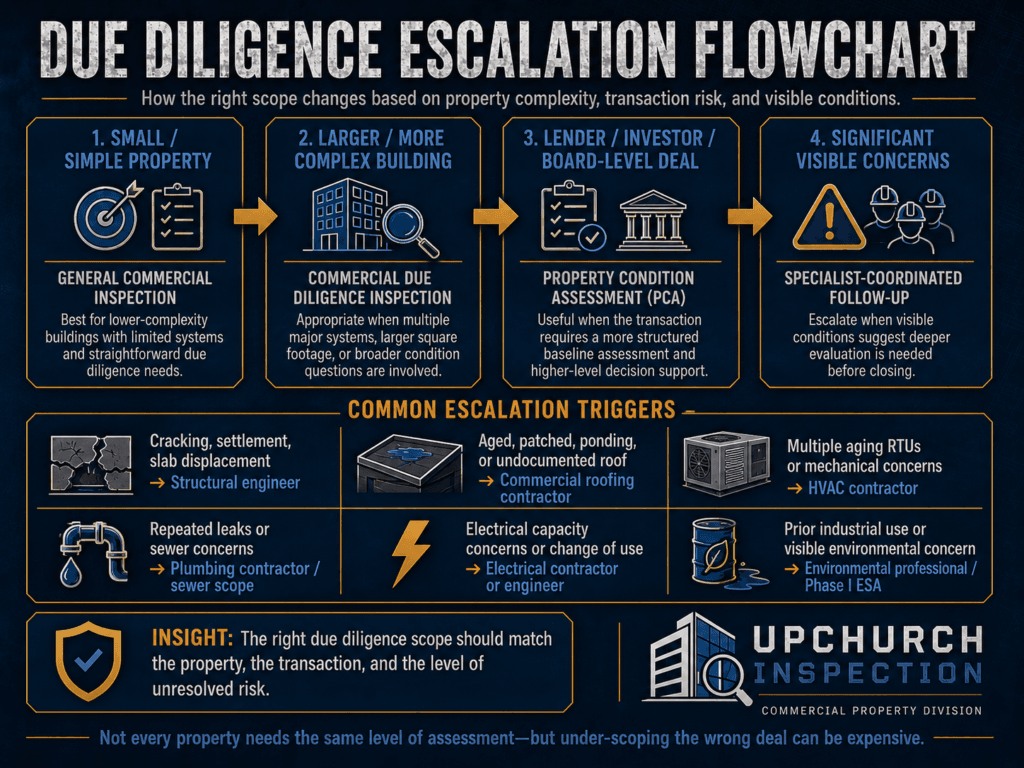
This is especially important for church campuses, warehouses, multifamily properties, medical or daycare facilities, industrial buildings, properties with multiple roofs or HVAC systems, buildings with known deferred maintenance, and properties where the buyer plans a change of use.
The goal is not to make the inspection more complicated than necessary.
The goal is to make the due diligence match the risk.
A basic inspection may be perfectly reasonable for a small, simple building. But it may be under-scoped for a multi-building church campus, older apartment complex, large warehouse, industrial property, or lender-involved PCA. A buyer should not pay for scope they do not need, but they also should not expect a limited walkthrough to answer questions it was never designed to answer.
This is how higher-level commercial inspection work should be framed.
Not as “more expensive inspection.”
As the appropriate level of due diligence for the property and decision.
Buyer’s Quick-Scan Checklist for Commercial Property Walkthroughs
This checklist is not a substitute for a commercial inspection, Property Condition Assessment, engineering review, environmental review, or specialist evaluation. It is a first-walkthrough tool to help buyers, brokers, trustees, investors, and property owners recognize conditions that may deserve closer review before closing.
1. Roof and Drainage
Look for visible ponding water, heavy roof patching, clogged roof drains, damaged gutters, stained ceiling tiles, roof stains, open seams, deteriorated flashing, or evidence of prior roof leaks.
2. Site Water Management
Look at whether water appears to move toward the building, pond in parking areas, collect near loading docks, discharge at the foundation, erode soil, or collect near exterior walls and slab edges.
3. Rooftop HVAC Units
Look for rooftop units that appear aged, rusted, poorly maintained, undocumented, or clustered in age so that several may require replacement around the same time.
4. Parking Lot and Exterior Access
Look for potholes, alligator cracking, failed patching, uneven sidewalks, trip hazards, damaged curbs, poor striping, ponding water, deteriorated ramps, or unsafe pedestrian paths.
5. Plumbing Patterns
Look for repeated stains, soft floors, active leaks, patched drain lines, loose toilets, old water heaters, ceiling stains below wet areas, or recurring water damage in more than one area.
6. Electrical Condition and Future Use
Look for panels that are poorly labeled, blocked, damaged, outdated, modified, or possibly inadequate for the buyer’s intended use. Watch for open junction boxes, exposed wiring, missing covers, and abandoned wiring.
7. Slab and Structural Clues
Look for displaced cracks, settlement, spalling, uneven warehouse floors, masonry cracks, door alignment issues, sloped floors, or visible movement that may affect operations.
8. Exterior Envelope
Look for failed sealants, deteriorated windows or doors, open masonry joints, wall penetrations that are poorly sealed, parapet deterioration, exterior staining, and moisture entry points.
9. Life Safety and Public Use
Look for visibly unsafe stairs, handrails, guards, exits, emergency lighting, walking surfaces, public-access areas, blocked exits, or poor exterior access conditions.
10. Documentation Gaps
Ask whether the seller can provide roof records, HVAC service history, warranty information, repair invoices, prior reports, utility information, maintenance contracts, and documentation of major repairs.
If several of these concerns appear during the first walkthrough, the buyer should consider a deeper commercial due diligence inspection, Property Condition Assessment, or specialist-coordinated assessment before the inspection period expires.
Use the Report Before the Inspection Period Expires
The inspection period is when the buyer still has leverage.
After closing, the buyer can still repair problems, but they usually cannot renegotiate the deal. That is why commercial inspection findings should be reviewed while there is still time to act.
A buyer may use the report to request records, bring in specialists, obtain bids, extend the due diligence period, renegotiate the price, seek repair credits, adjust capital reserves, revise financing assumptions, or walk away if the physical risk no longer supports the deal.
Not every defect changes a transaction. Some findings are ordinary maintenance. Some are repair items. Some require monitoring. But some findings should change the buyer’s understanding of the property.
That is the point of commercial due diligence.
The report should not sit unread until closing. It should be used while the buyer still has options.
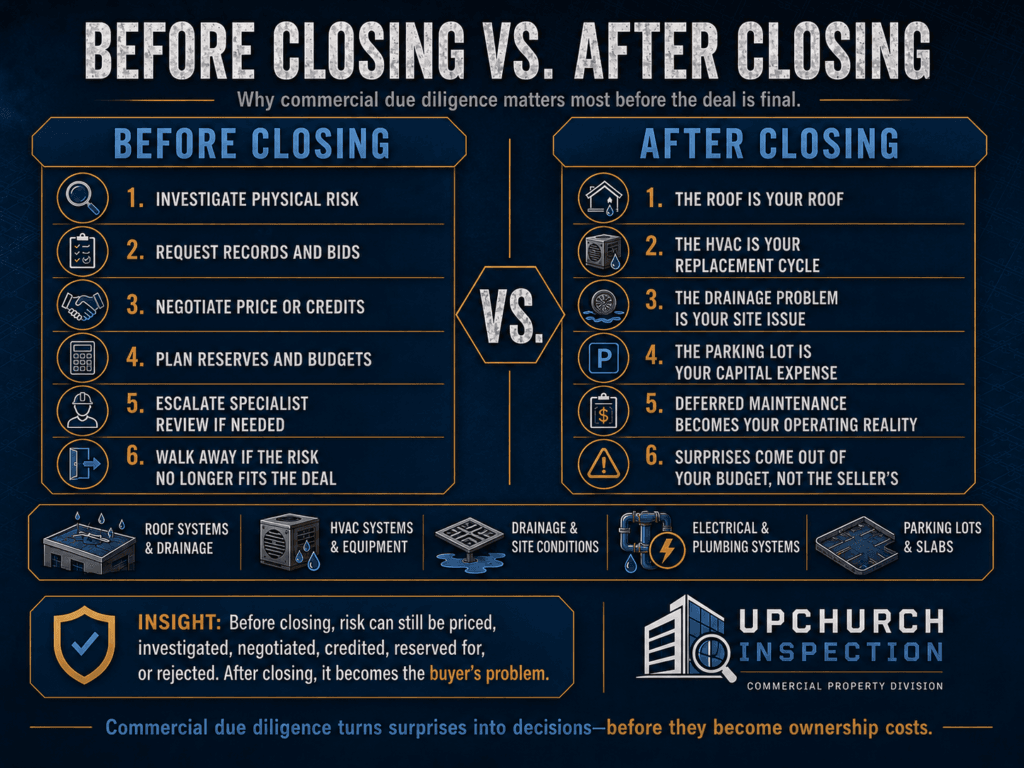
Conclusion: Before Closing, Risk Can Still Be Priced, Investigated, or Negotiated
A commercial building does not have to be failing to be risky.
It only has to carry more future cost than the buyer understood before closing.
That is the reason commercial due diligence matters. Roofs, HVAC systems, drainage, plumbing, electrical service, slabs, parking lots, exterior envelopes, life-safety observations, accessibility-related concerns, and deferred maintenance all affect the real cost of ownership. Some conditions require immediate attention. Some require specialist evaluation. Some belong in capital reserves. Some may affect the purchase price. Some may simply help the buyer plan better.
The purpose of a commercial inspection is not to find reasons to kill a deal.
It is to make sure the buyer understands the deal.
Before closing, physical risk can still be studied, priced, negotiated, credited, reserved for, or rejected. After closing, the roof is the buyer’s roof. The HVAC systems are the buyer’s equipment. The drainage problem is the buyer’s site issue. The parking lot is the buyer’s capital expense. The deferred maintenance becomes the buyer’s operating reality.
A commercial building is not just a structure.
It is an asset with obligations attached.
The job of commercial due diligence is to identify those obligations before they become surprises.
Professional Limitation Note
This report is provided for general educational and commercial due diligence discussion purposes. It does not replace a property-specific inspection, Property Condition Assessment, structural engineering evaluation, environmental assessment, code compliance review, fire/life-safety inspection, ADA compliance audit, roof certification, contractor pricing, legal advice, or financial advice.
Site-specific conditions should be evaluated by qualified professionals based on the property, scope, and intended use. Commercial buyers, investors, trustees, lenders, and property owners should use this report as a risk-awareness tool, not as a substitute for property-specific due diligence.
Need a Commercial Property Inspection or PCA?
Upchurch Inspection provides commercial property inspections and Property Condition Assessments for buyers, investors, trustees, lenders, property owners, and real estate professionals throughout the Mid-South.
We help clients evaluate visible building conditions, deferred maintenance, roof and drainage concerns, HVAC systems, plumbing, electrical service, site conditions, slabs, exterior envelope issues, life-safety observations, and potential capital expense risks before closing, refinancing, budgeting, or major investment.
For commercial buildings, churches, campuses, warehouses, industrial properties, multifamily buildings, offices, retail spaces, medical/daycare facilities, and mixed-use assets, we can help determine the right inspection scope for the decision being made.
To discuss a commercial inspection, Property Condition Assessment, or specialist-coordinated commercial assessment, contact Upchurch Inspection.